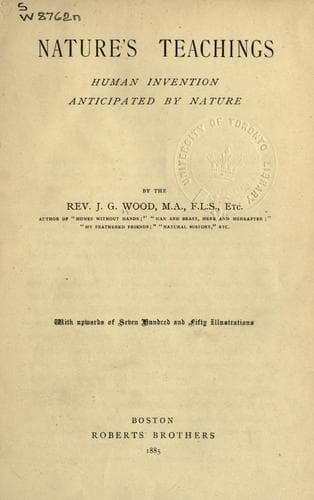
Nature's Teachings: Human Invention Anticipated by NatureWood, J. G. (John George)
History
Nature's Teachings: Human Invention Anticipated by Nature
Wood, J. G. (John George)
Inventions; Natural history
In either of these cases the fallen knight was not much the worse, until
a weapon called the “Misericorde,” or dagger of mercy, was invented.
This was a poniard with a very slender and very sharp blade, so
constructed that it could be driven between the joints of the armour,
and thus inflict a mortal wound. The Misericorde, however, was baffled
by the use of chain or scale armour under the plate-mail, and then the
only way of getting at the fallen knight was by breaking up the armour
with hammers which were made for this express purpose.
Perhaps the reader may wonder that any one should lie quietly and allow
himself to be so badly treated. The very strength of the armour,
however, which rendered its wearer unassailable by ordinary weapons,
involved so much weight, that when a knight had fallen, it was
impossible for him to rise, much less to mount a horse, without help.
Moreover, the first blow of a weighty hammer on the helmet would,
although it could not kill the wearer, cause such a jar to his brain as
partially, if not wholly, to stun him.
The rapidly increasing power of firearms soon caused armour to be laid
aside, and now the only remains of it are to be found in the helmets and
cuirasses worn by our dragoons.
* * * * *
THERE are few parts of the world where armour of some sort is not used.
Putting aside civilised or semi-civilised nations, we find that in most
cases, wherever there is war, there is armour of some kind. Sometimes it
is movable, and in that case is called a shield.
The most singular shields that I know are those made by the Australians,
which are so shaped that no one who did not know their use would take
them for shields. They are about three feet long, four inches wide at
the back, six inches or so thick in the middle, tapering towards the
ends, and coming to an edge in front. They are held by the centre with
one hand, so that they can be rapidly twisted from side to side, and so
serve to parry the spear or stop the boomerang. The weight of the shield
enables it to withstand the shock of the boomerang, which whirls through
the air with terrific force.
Several warlike savage tribes have, however, no armour of any kind, such
as the New Zealanders, the Samoans, and the Fijians.
Sometimes the armour is affixed to the body, and of such protection many
examples are to be found in various museums, among which the Christy
collection is pre-eminent.
Among the Polynesians cocoa-nut fibre was at one time employed as the
material for armour. It was twisted into small cords, and with these a
sort of armour was constructed, quite strong enough to resist any weapon
that an enemy of their own kind could bring against them. Sometimes this
armour was merely a belt wide enough to protect the abdomen, but
sometimes the whole body was defended, from the neck to the hips.
Public-domain text, read in full here on John Shaqi.
Reviews
Reviews
No reviews yet
Be the first to share your thoughts on this work.
Elsewhere in the archive
Join the Discussion
Join the discussion
Sign in to leave a comment or review.
Sign InorCreate an account