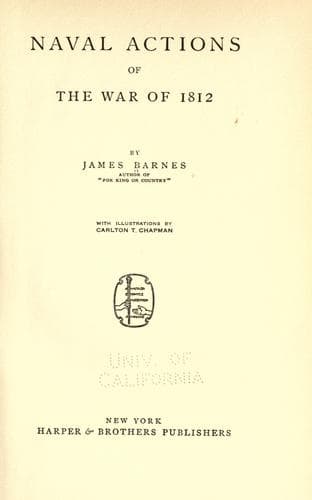
United States -- History -- War of 1812 -- Naval operations
Early in January, 1814, the blockading forces at New London were the
_Ramillies_ (74), Commodore Sir Thomas Hardy; the _Endymion_, Captain
Hope; and the _Statira_, frigate, Captain Stackpole. There were also
one or two smaller armed vessels within call. Upon one occasion an
American prisoner of war, who was about to be landed at New London in
exchange, was present during a conversation among the English officers,
who, tired of acting as jailers, were anxious for a conflict. Upon
landing he reported what he had heard to the Americans, and Captain
Biddle, under a flag of truce, obtained an interview with Sir Thomas
Hardy on board the _Ramillies_. He did his best to secure a meeting
between the two frigates _United States_ and the _Macedonian_ on one
side, and the _Endymion_ and the _Statira_ on the other.
Sir Thomas, after thinking the matter over, declined the meeting
between the _Endymion_ and the _United States_ on account of the
difference in force; the captain of the _Statira_ did not wish to try
it alone, and so the meeting fell through. And what a strange comment
upon the pomp and circumstance of war! Biddle was so anxious himself to
fight, and so trusted in the honor of the enemy, that, hearing that a
British corvette was shortly to join the station, he would have sailed
out through the hostile fleet in the _Hornet_ to meet her all alone. It
was the _Loup-Cervier_ that was soon expected to arrive; this vessel
had once been the tidy American sloop of war the _Wasp_, and Biddle had
been second in command of her. Now, however, she was under a Captain
Mends, and flew, instead of the “sailors’ rights,” the cross of St.
George. However, after some correspondence, the meeting was given up,
much to Biddle’s chagrin, and the rechristened _Loup-Cervier_ sailed
out to sea after delivering despatches.
All through the winter a close blockade of New London was kept up, and
it was found impossible to make any escape. At last the government
ordered the two American frigates to be moved up the Thames as far
as possible, and there they were dismantled. The officers and crew
were transferred to other cities, while Captain Biddle was ordered to
continue at New London for the protection of the shipping. In vain he
protested against this hopeless and mortifying situation. The enemy
made no serious preparations for trying to take the force up the
river, and at last Biddle succeeded in obtaining permission to try to
sail through the British fleet. Leaving the _United States_ and the
_Macedonian_ protected by land batteries, he placed the _Hornet_ in the
best of trim, and on the night of the 18th of November, undiscovered,
he drifted past the guard-ships and arrived safely at New York. It was
seventeen months since he had been free.
Public-domain text, read in full here on John Shaqi.
Reviews
Reviews
No reviews yet
Be the first to share your thoughts on this work.
Elsewhere in the archive
Join the Discussion
Join the discussion
Sign in to leave a comment or review.
Sign InorCreate an account