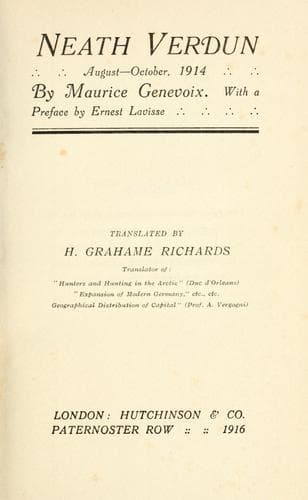
'Neath Verdun, August-October, 1914Genevoix, Maurice
History
'Neath Verdun, August-October, 1914
Genevoix, Maurice
Verdun, Battle of, Verdun, France, 1914
We march through a narrow clearing which is no more than a ribbon of
black earth between piles of dead leaves on the one side, and
all-invading moss on the other. The thickets are dense and filled with
a sea-green penumbra. The sinking sun is directly behind us. Its
failing light streams over the moving file of men, leaving golden
reflections in the tin bowls fastened to their packs. The heads of the
men rise and fall with their unequal steps, causing an undulation to
pass from one end of the section to the other.
There is no talking. Our feet make no noise on that moist earth, in
which each nail leaves a clear imprint. Occasionally, a timid
twittering is heard amid the silence, as faint and self-effacing as
the failing sun-rays gliding into the undergrowth between the leaves
of the trees.
Suddenly the surly detonation of a 75 shatters the peace; soon all the
guns hidden in the wood intone a brutal chorus; the clamour envelops
us; each shot seems to hurtle past with a violence sufficient to burst
the gun firing it. Then a murmuring echo flies from valley to valley,
gradually becoming weaker and weaker until swamped by the tremendous
outburst of another salvo. To all this noise, however, we are
strangely used. It seems in some curious way to mingle with the
material things about us, to harmonize with them, to belong as it were
to the melancholy of the dying day. We no longer jump as the guns
speak; we no longer hear them; we are conscious only of the curious
melody of the echoes which decrease and decrease, then sound anew with
increased force, decrease again and increase again, finally to die
away in a sad, tremulous murmur which spreads far away over the earth.
The evening draws on. We are approaching the edge of the wood. Beside
the road lie some tattered knapsacks, some shattered bayonets; a
little further on blood-stained bandages are lying on the moss,
shirts, a flannel waist-band, some nameless rags, the lining of a
waistcoat; further on again the body of a dead man appears stretched
to his full length, face turned to the earth.
All along the edge of the clearing are shell-holes at almost regular
intervals; enormous roots which have been shattered display their pale
wounds. Then the shell-holes concentrate, all of them being still
within the clearing, mute evidences of an admirably-directed fire. The
men affirm that our artillery placed a barrage along this marked line
on the evening of the 24th. They have such simple faith, these men, in
the power of our guns! It may or may not have been so; personally I
prefer to believe that it was so.
We halt a little before attaining the edge of the wood in a clearing
surrounded by giant trees whose waving tops are lost to sight in the
darkening sky.
Public-domain text, read in full here on John Shaqi.
Reviews
Reviews
No reviews yet
Be the first to share your thoughts on this work.
Elsewhere in the archive
Join the Discussion
Join the discussion
Sign in to leave a comment or review.
Sign InorCreate an account