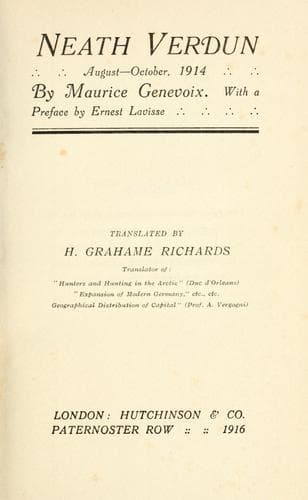
'Neath Verdun, August-October, 1914Genevoix, Maurice
History
'Neath Verdun, August-October, 1914
Genevoix, Maurice
Verdun, Battle of, Verdun, France, 1914
Above all can I hear the crackling of the enemy's rifles. They sound
sharply, exactly opposite us; but the bullets seem to come from a
great distance, which serves to thin them out. I recall Vauxmarie, the
firing at thirty yards, then at ten, then at point-blank range. The
present fusillade is not like that, and I feel sure that up to the
present the Germans have not yet left their trenches. More than that,
I feel convinced they will not leave them. On the other side of the
ravine, taking cover in a trench similar to ours, behind a similar
breastwork, they, too, tremble at every rustling of the leaves. The
night was the same for all men in the wood; like ourselves, the Boches
were afraid.
A star shell rises high in the sky and bursts into startling
resplendency; so strong was the light with which it flooded the earth
that the shadow of each branch, of each leaf, was projected in minute
perfection of detail upon the whitened surface of the parapet, on our
faces, on our hands.
The star streamed through the heavens until a gust of wind made it
waver; then it commenced to descend slowly and leisurely until finally
dying from sight. And then the darkness was more impenetrable than
ever.
The fusillade had burst out from the enemy's trenches more violently
than ever the moment the wan, pale light of the star irradiated the
earth. Now the darkness has again descended, the firing does not
decrease. Rather the whistling of bullets increases. Other star shells
rise and burst; on each occasion I see the rank of my men, one
pressing against the other, necks extended, watching closely the
course of the star.
A bullet strikes a metal object behind me, doubtless some old
water-flask. The sound brings me to attention again. I listen to the
bullets, their whining, the dead thud they make against the trunks of
the trees, the lash-like hissing they make when flying far towards the
trenches of the reserve, the long-drawn, the musical note of those
flying still higher and passing over the hilltop into space.
The steps of someone approaching are heard. Someone is coming, walking
evenly and steadily, through the mortal hail. I see the man is erect;
he is following the line of the trenches; from time to time he halts
and bends a little, as though to speak to those in the trench, well
sheltered from the shots. Then he rises and, quite erect, continues on
his way, thrusting aside the brambles with a stick in his hand. In
this way, with the same appearance of indifference and nonchalance, he
passes through the leaden tempest raging about the terrain which
separates us from the neighbouring trench. A few yards from me he
seems to hesitate, moves back a little while looking about him, then
in a low voice he calls my name.
"I am here," I say. "Can you hear me? Come towards my voice."
And Porchon, seating himself tranquilly on the parapet, his legs in
the trench, his head and body exposed to the bullets, offers me his
hand, saying:
"Good evening, old man."
Public-domain text, read in full here on John Shaqi.
Reviews
Reviews
No reviews yet
Be the first to share your thoughts on this work.
Elsewhere in the archive
Join the Discussion
Join the discussion
Sign in to leave a comment or review.
Sign InorCreate an account