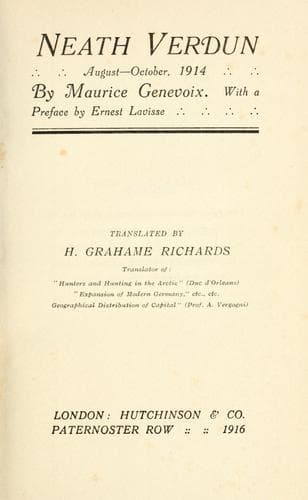
'Neath Verdun, August-October, 1914Genevoix, Maurice
History
'Neath Verdun, August-October, 1914
Genevoix, Maurice
Verdun, Battle of, Verdun, France, 1914
It is Toul wine, dry, thin and somewhat sharp. A brawn, turned out on
to a plate, gives us an excellent lunch.
In the afternoon we pass to the observation trench. We overtake a
group of lame men, without weapons, coats open, almost all of them
limping along with a stick. Among them I recognize a friend of pre-war
days. We shake hands and speak eagerly and with pleasure of common
memories, before approaching the inevitable regrets. As he belonged to
a regiment which was compelled to give way before the Boches, I asked
him how it had come about. He shrugged his shoulders despondently.
"Masses of infantry; an endless hail of shell; not a gun to support us
... don't let's talk about it, old man."
After the iciness of the preceding night, a day of burning sunshine. I
am wearing ridiculously thin boots, which decrease in size as my feet
swell. I give stones a wide berth.
To the right of the road the fields roll away like a great cloth,
fresh and green until they reach the heights covered with trees, whose
luxuriant foliage seems to fall from the top to the bottom of the
slopes.
"Single file through the cutting."
That is the sign that we are entering the zone of fire of the German
guns. We climb and pass through the village of Mouilly, built on the
side of a slope. Almost all the houses, with their plaster façades,
are on one side of the road, the left. On the other side meadows
stretch away to where the sun rises and where the green of the wooded
highlands begins its cascade to the plains below. Enormous shell-holes
mark the meadows, about which the upflung earth forms brown circles
which look from the distance like enormous stains.
Woods. Some shrapnel bursts ahead of us, but far away. In the cutting
we encounter a big grey motor-car, ornamented with gilt letters. One
of its wheels has been blown away and its steel sides bear the mark of
shells: it was the product of some great Leipzig firm.
We overtake a regiment of the division at the end of the wood on the
Mouilly-Saint-Rémy road. A fight has taken place, and our 75's are
still sending down a rain of shells, forming a barrage some five
hundred yards before us. We stand and watch it, Porchon and I,
together with the two officers we are going to relieve. They are both
fine soldiers and speak unaffectedly of the battle they have just
passed through. One of them, tall, bony, with tanned skin and black
eyes almost feverishly keen above a fine nose, expresses himself
shortly and precisely. The second, small, rather too affable, with a
wrinkled face, laughing eyes, fresh lips and a brown beard, entertains
us with a recital of horrors in a cheerful voice and warns us that we
are very likely to "leave our skins over there."
Public-domain text, read in full here on John Shaqi.
Reviews
Reviews
No reviews yet
Be the first to share your thoughts on this work.
Elsewhere in the archive
Join the Discussion
Join the discussion
Sign in to leave a comment or review.
Sign InorCreate an account