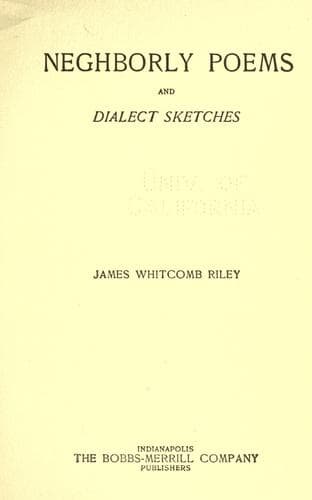
Neghborly Poems and Dialect SketchesRiley, James Whitcomb
General
Neghborly Poems and Dialect Sketches
Riley, James Whitcomb
Dialect literature, American; Dialect poetry, American
"Annie! My wife!" he says; and Annie she
kindo' give a little yelp like and come a-flutterin' down in his arms;
and the jug o' worter rolled clean acrost the road, and turned a
somerset and knocked the cob out of its mouth and jist laid back and
hollered "Good--good--good--good--good!" like as ef it knowed what was
up and was jist as glad and tickled as the rest of us.
DIALECT IN LITERATURE
"_And the common people heard him gladly._"
Of what shall be said herein of dialect, let it be understood the term
dialect referred to is of that general breadth of meaning given it
to-day, namely, any speech or vernacular outside the prescribed form of
good English in its present state. The present state of the English is,
of course, not any one of its prior states. So first let it be remarked
that it is highly probable that what may have been the best of English
once may now by some be counted as a weak, inconsequent _patois_, or
dialect.
To be direct, it is the object of this article to show that dialect is
not a thing to be despised in any event--that its origin is oftentimes
of as royal caste as that of any speech. Listening back, from the
standpoint of to-day, even to the divine singing of that old classic
master to whom England's late laureate refers as
"... the first warbler, whose sweet breath
Preluded those melodious bursts that fill
The spacious times of great Elizabeth
With sounds that echo still";
or to whom Longfellow alludes, in his matchless sonnet, as
"... the poet of the dawn, who wrote
The Canterbury Tales, and his old age
Made beautiful with song";--
Chaucer's verse to us is _now_ as veritably dialect as to that old time
it _was_ the chastest English; and even then his materials were
essentially dialect when his song was at best pitch. Again, our present
dialect, of most plebeian ancestry, may none the less prove worthy.
Mark the recognition of its own personal merit in the great new
dictionary, where what was, in our own remembrance, the most outlandish
dialect, is now good, sound, official English.
* * * * *
Since Literature must embrace all naturally existing
materials--physical, mental, and spiritual--we have no occasion to urge
its acceptance of so-called dialect, for dialect _is_ in Literature,
and _has_ been there since the beginning of all written thought and
utterance. Strictly speaking, as well as paradoxically, all verbal
expression is more or less dialectic, however grammatical. While usage
establishes grammar, it no less establishes so-called dialect.
Therefore we may as rightfully refer to "so-called grammar."
Public-domain text, read in full here on John Shaqi.
Reviews
Reviews
No reviews yet
Be the first to share your thoughts on this work.
Join the Discussion
Join the discussion
Sign in to leave a comment or review.
Sign InorCreate an account