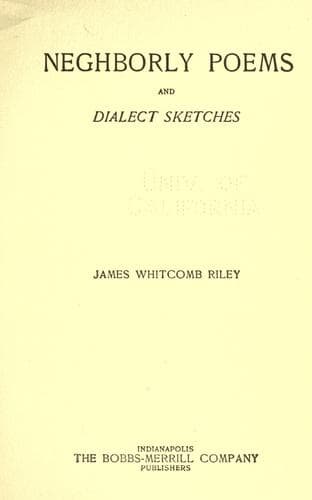
Neghborly Poems and Dialect SketchesRiley, James Whitcomb
General
Neghborly Poems and Dialect Sketches
Riley, James Whitcomb
Dialect literature, American; Dialect poetry, American
It is not really a question of Literature's position toward dialect
that we are called upon to consider, but rather how much of
Literature's valuable time shall be taken up by this dialectic country
cousin. This question Literature her gracious self most amiably answers
by hugging to her breast voluminous tomes, from Chaucer on to Dickens,
from Dickens on to Joel Chandler Harris. And this affectionate spirit
on the part of Literature, in the main, we all most feelingly indorse.
Briefly summed, it would appear that dialect means something more than
mere rude form of speech and action--that it must, in some righteous
and substantial way, convey to us a positive force of soul, truth,
dignity, beauty, grace, purity and sweetness that may even touch us to
the tenderness of tears. Yes, dialect as certainly does all this as
that speech and act refined may do it, and for the same reason: it is
simply, purely natural and human.
Yet the Lettered and the Unlettered powers are at swords' points; and
very old and bitter foemen, too, they are. As fairly as we can, then,
let us look over the field of these contending forces and note their
diverse positions: First, _the Lettered_--they who have the full
advantages of refined education, training, and association--are
undoubtedly as wholly out of order among _the Unlettered_ as the
Unlettered are out of order in the exalted presence of the Lettered.
Each faction may in like aversion ignore or snub the other; but a
long-suffering Providence must bear with the society of both. There may
be one vague virtue demonstrated by this feud: each division will be
found unwaveringly loyal to its kind, and mutually they desire no
interchange of sympathy whatever.--Neither element will accept from the
other any _patronizing_ treatment; and, perhaps, the more especially
does the _Unlettered_ faction reject anything in vaguest likeness of
this spirit. Of the two divisions, in graphic summary,--_one_ knows
the very core and centre of refined civilization, and this only; the
_other_ knows the outlying wilds and suburbs of civilization, and this
only. Whose, therefore, is the greater knowledge, and whose the just
right of any whit of self-glorification?
Public-domain text, read in full here on John Shaqi.
Reviews
Reviews
No reviews yet
Be the first to share your thoughts on this work.
Join the Discussion
Join the discussion
Sign in to leave a comment or review.
Sign InorCreate an account