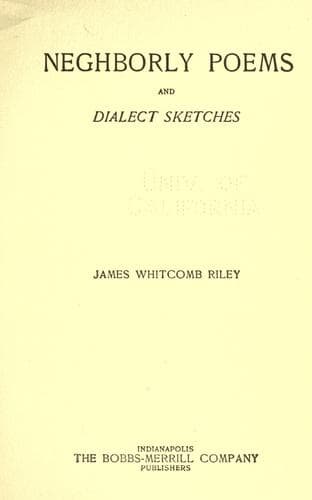
Neghborly Poems and Dialect SketchesRiley, James Whitcomb
General
Neghborly Poems and Dialect Sketches
Riley, James Whitcomb
Dialect literature, American; Dialect poetry, American
Let no impious faddist, then, assume its just interpretation. He may
know everything else in the world, but not dialect, nor dialectic
people, for both of which he has supreme contempt, which same, be sure,
is heartily returned. Such a "superior" personage may even go among
these simple country people and abide indefinitely in the midst of
them, yet their more righteous contempt never for one instant permits
them to be their real selves in his presence. In consequence, his most
conscientious report of them, their ways, lives, and interests, is
absolutely of no importance or value in the world. He never knew them,
nor will he ever know them. They are not his kind of people, any more
than he is their kind of man; and _their_ disappointment grieves us
more than his.
The master in Literature, as in any art, is that "divinely gifted man"
who does just obeisance to all living creatures, "both man and beast
and bird." It is this master only who, as he writes, can sweep himself
aside and leave his humble characters to do the thinking and the
talking. This man it is who celebrates his performance--not himself.
His work he celebrates because it is not his only, but because he feels
it the conscientious reproduction of the life itself--as he has seen
and known and felt it;--a representation it is of God's own script,
translated and transcribed by the worshipful mind and heart and hand of
genius. This virtue in all art is impartially demanded, and genius only
can fully answer the demand in any art for which we claim perfection.
The painter has his expression of it, with no slighting of the
dialectic element; so, too, the sculptor, the musician, and the list
entire. In the line of Literature and literary material, an
illustration of the nice meaning and distinction of dialectic art will
be found in Charles Dudley Warner's comment of George Cable's work, as
far back as 1883, referring to the author's own rendition of it from
the platform. Mr. Warner says:
Public-domain text, read in full here on John Shaqi.
Reviews
Reviews
No reviews yet
Be the first to share your thoughts on this work.
Elsewhere in the archive
Join the Discussion
Join the discussion
Sign in to leave a comment or review.
Sign InorCreate an account