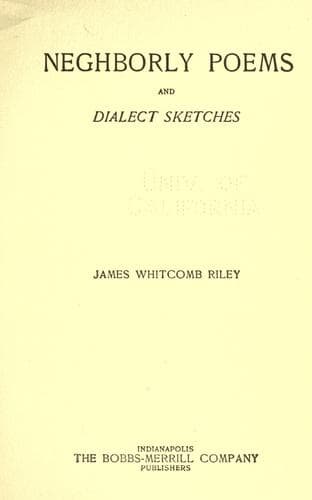
Neghborly Poems and Dialect SketchesRiley, James Whitcomb
General
Neghborly Poems and Dialect Sketches
Riley, James Whitcomb
Dialect literature, American; Dialect poetry, American
A curious thing, indeed, is this factional pride, as made equally
manifest in both forces; in one, for instance, of the Unlettered
forces: The average farmer, or countryman, knows, in reality, a far
better and wider range of diction than he permits himself to use. He
restricts and abridges the vocabulary of his speech, fundamentally, for
the reason that he fears offending his rural _neighbors_, to whom a
choicer speech might suggest, on his part, an assumption--a spirit of
conscious superiority, and therewith an implied reflection on _their_
lack of intelligence and general worthiness. If there is any one text
universally known and nurtured of the Unlettered masses of our common
country, it is that which reads, "All men are created equal." Therefore
it is a becoming thing when true gentility prefers to overlook some
variations of the class who, more from lack of cultivation than out of
rude intent, sometimes almost compel a positive doubt of the nice
veracity of the declaration, or at least a grief at the munificent
liberality of the so-be-quoted statement. The somewhat bewildering
position of these conflicting forces leaves us nothing further to
consider, but how to make the most and best of the situation so far as
Literature may be hurt or helped thereby.
Equally with the perfect English, then, dialect should have full
justice done it. Then always it is worthy, and in Literature is thus
welcome. The writer of dialect should as reverently venture in its use
as in his chastest English. His effort in the _scholarly_ and _elegant_
direction suffers no neglect--he is _schooled_ in that, perhaps, he may
explain. Then let him be _schooled_ in _dialect_ before he sets up as
an expounder of it--a teacher, forsooth a master! The real master must
not only know each varying light and shade of dialect expression, but
he must as minutely know the inner character of the people whose native
tongue it is, else his product is simply a pretence--a wilful forgery,
a rank abomination. Dialect has been and is thus insulted, vilified,
and degraded, now and continually; and through this outrage solely,
thousands of generous-minded readers have been turned against dialect
who otherwise would have loved and blessed it in its real form of crude
purity and unstrained sweetness--
"Honey dripping from the comb!"
Public-domain text, read in full here on John Shaqi.
Reviews
Reviews
No reviews yet
Be the first to share your thoughts on this work.
Elsewhere in the archive
Join the Discussion
Join the discussion
Sign in to leave a comment or review.
Sign InorCreate an account