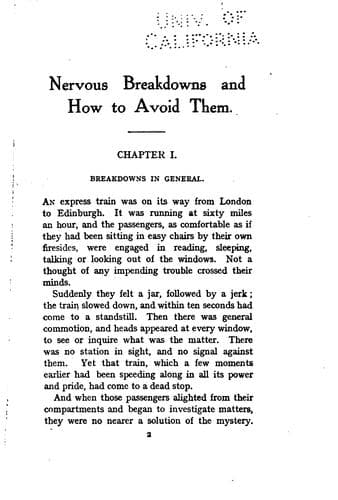
Nervous Breakdowns and How to Avoid ThemMusgrove, Charles David
Science
Nervous Breakdowns and How to Avoid Them
Musgrove, Charles David
Mental health
Now what was it that was troubling him? In the first place he was
tired. That was not to be wondered at, seeing that he had conducted
three services in the course of the day. Most persons from the navvy to
the king feel tired when their day’s work is finished, but this does
not worry them. There is no more delightful sensation than that of real
fatigue.
What chiefly troubled him was the fact that although the book he was
trying to read was one dealing with spiritual matters, he was not only
unable to give his mind to it, but could not even arouse any interest
in the subject. He did not see that it was the most natural thing in
the world that this should be so. If a surgeon were to perform three
operations in one day, I am quite sure that he would wish to talk
or think about anything except surgery. And if a pianist gave three
recitals in the day, I believe that the last subject which would
interest him would be music. His faculty for it, like the surgeon’s for
his own art, would be exhausted for the time being. Why then should the
parson who had thrown all his spiritual energies into his Sunday’s work
be surprised to find that his active interest in such matters was in
abeyance? His faculties had been confined to a certain groove all day,
and refused to work any longer on those lines.
That parson was only a type, if a pronounced one, of many other people,
business men, lawyers, doctors, stockbrokers and any other you can
mention, who cannot make out how it is that if they think of their work
in the evenings they only worry over it. Yet it forces itself upon
their notice, and they cannot shake it off. They seek rest and find
none because they seek it in the wrong way. They try to sit still and
think of nothing, and that is the most difficult thing on earth for any
intelligent human being to attempt.
We can arrest the movements of the body, but it is infinitely more
difficult to stop the workings of the mind. The engine is going at full
speed, and we are unable to pull it up. But we can do something equally
efficacious, we can switch it on to a different line.
[Sidenote: Change is rest.]
We can give it change. And change is rest. There is nothing more
wearying to a mind that is tired and yet strung up than for any man or
woman to sit gazing moodily at the fire, fretting their nervous systems
with the worries that should have been left behind. Recreation is as
indispensable to health as food itself.
A fascinating novel, a pleasant game or an absorbing hobby will afford
the wearied brain its much-needed relaxation.
And when, in one or other of these ways, the mind has been enabled
to settle down into a quieter groove, it will be in a vastly better
condition to secure the ideal form of rest, nature’s sweet restorer,
sleep.
So important are these considerations, sleep, recreation and a kindred
one, holidays, that they deserve more than a passing reference. In the
next few chapters, therefore, we shall describe them more fully.
Public-domain text, read in full here on John Shaqi.
Reviews
Reviews
No reviews yet
Be the first to share your thoughts on this work.
Elsewhere in the archive
Join the Discussion
Join the discussion
Sign in to leave a comment or review.
Sign InorCreate an account