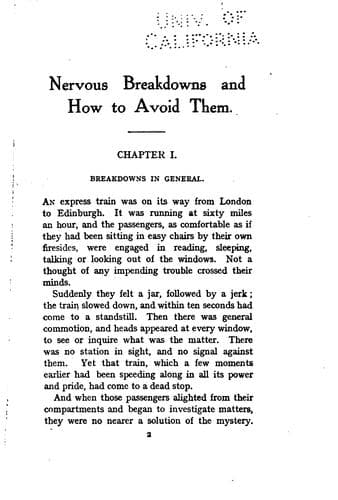
Nervous Breakdowns and How to Avoid ThemMusgrove, Charles David
Science
Nervous Breakdowns and How to Avoid Them
Musgrove, Charles David
Mental health
Regular and early hours are essential to health, and the neglect of
them is often the means of starting a breakdown, or bringing it to a
head. Many cases of insomnia are due to a want of punctuality in this
respect. And of all the tortures with which mankind can be afflicted
there is none worse than insomnia, and none that so surely undermines
the nervous system. One of the most vital points in the prevention of
breakdowns is to consider the different ways in which sleep can be
obtained--and to carry them out.
[Sidenote: Punctuality in going to bed.]
To emphasise what we have just said, punctuality in going to bed is
the most important point of all. The brain, like the digestion, has a
marked tendency to get into habits, either bad or good. And if anyone
goes to bed at different times, later on some evenings than others,
the brain is liable to select the latter hour as the one for falling
asleep. This means that even on the nights when people go to bed in
good time they cannot get to sleep for the next hour or two. If they
would stick to the one hour regularly, the brain would soon learn to do
the same.
Dozing in front of the fire in the evenings is responsible for many
bad nights. The mind gets into a half-awake, half-sleepy state, which
hinders it from obtaining sound slumber when bedtime comes. Even if
people are tired and sleepy at, say, nine o’clock, it is better for
them to read or play a game or move about in order to avoid falling
into a doze.
A brisk walk of ten minutes or so before retiring is often found to be
one of the best sleep-producers. Or if the weather be too inclement, a
few physical exercises will have the same effect.
[Sidenote: Avoid late suppers.]
Late or heavy suppers are a common cause of insomnia, especially that
form of it in which people fall into a heavy sleep, only to awake with
a start an hour or two later and find themselves unable to drop off
again until early morning perhaps.
Digestion comes almost to a dead stop during sleep, so that sufficient
time should be allowed for the last meal to be disposed of before the
hour for retiring. This interval should be two hours at least, which
means that half-past eight is, as a rule, late enough for the evening
meal. In any case, the food which is taken then ought to be of a light
nature, and not include pork, cold meat, or any other article of diet
which is slow of digestion. Coffee and strong tea, especially Indian
tea, are unsuitable at this hour, as they tend to cause sleeplessness
of themselves. Cocoa, made with water, is a much better beverage for
use with the evening meal or after it.
Sometimes, however, too long an interval between the last meal and
bedtime will prevent sleep, as in the case of those who take high tea
at half-past six, or dinner at seven or thereabouts. Under these
circumstances light refreshments, in the shape of a few biscuits with a
light drink of some sort, will assist sleep.
Public-domain text, read in full here on John Shaqi.
Reviews
Reviews
No reviews yet
Be the first to share your thoughts on this work.
Elsewhere in the archive
Join the Discussion
Join the discussion
Sign in to leave a comment or review.
Sign InorCreate an account