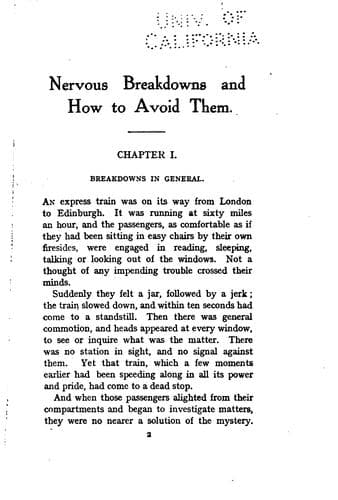
Nervous Breakdowns and How to Avoid ThemMusgrove, Charles David
Science
Nervous Breakdowns and How to Avoid Them
Musgrove, Charles David
Mental health
Whether headaches be due to this or any other cause, they should never
be neglected, especially if they are liable to come on while at work.
For repeated headaches, even though they may be but slight, have a
wearing effect on the brain and other parts of the nervous system. They
may be due to most trivial causes in some cases, which is all the more
pity why they should be allowed to persist. A man who was at the head
of a large firm once consulted a doctor because he found that his work
took it out of him more than before. The medical man noticed that the
patient was slightly deaf, though the latter did not seem to be aware
of the fact. On examination, the ears were found to be blocked with
wax, the removal of which restored the man to his usual state of health
and vigour. It had been simply the strain of trying to hear what was
being said which had produced a constant sense of fatigue.
[Sidenote: Midday rest.]
There is one custom which in these busy times tends to be dying out. It
is that of the midday meal rest, the old-fashioned forty winks. “There
is no time for it now,” people say. But there is time for everything,
if we choose to make it. The head of one of the largest firms in this
country used to insist on this rest, no matter how urgent the matters
might be that needed his attention. He kept a couch in his private
office, and each day, as soon as he had had his lunch, he locked the
door, and for twenty minutes took a comfortable rest and snooze. And
woe betide anyone who disturbed him. It was to this custom that he
attributed the fact that he had retained his faculties and vigour to an
age at which most of his confrères were dead or broken down.
Some may prefer to have a walk in the fresh air, and if their
occupation is a sedentary one and they have been cooped up in an office
all the morning, it will probably suit them better than lying down.
[Sidenote: Intervals between meals.]
It is not uncommon to find cases in which there is over-fatigue
because the intervals between the meals is too long, apart from any
circumstances which interfere with them. A man gets his breakfast at
eight o’clock and his lunch at half-past one it may be. He objects to
eating between meals, so takes nothing for the whole of that time. Now
this for most people is too long; the system becomes exhausted, and
has to do its work without proper nourishment. This means that it has
to draw upon the reserve forces, and while this may be done now and
then, it cannot be repeated often without depleting them. Many people
would find the greatest benefit from a little light refreshment in the
course of the morning. They do not need much: a cup of coffee or soup,
or a glass of milk and a biscuit, are quite sufficient to keep them
going until the luncheon hour.
Public-domain text, read in full here on John Shaqi.
Reviews
Reviews
No reviews yet
Be the first to share your thoughts on this work.
Elsewhere in the archive
Join the Discussion
Join the discussion
Sign in to leave a comment or review.
Sign InorCreate an account