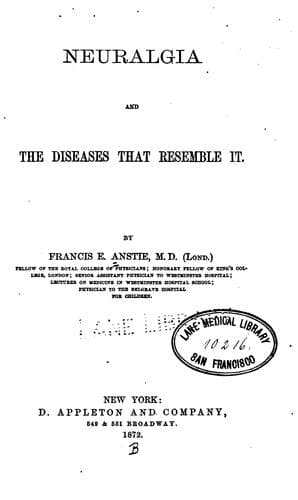
Neuralgia and the diseases that resemble itAnstie, Francis Edmund
Science
Neuralgia and the diseases that resemble it
Anstie, Francis Edmund
Neuralgia
subject, taken in conjunction with physiological experiments, and with
only the aid of a very few isolated facts of positive morbid anatomy. I
need hardly say that I am none the less anxious for that further
assurance which we shall one day, perhaps, obtain by means of
greatly-improved processes for microscopic detection of minute changes
in nerve-centres; but, looking to the necessary rarity of opportunities
for post-mortem examinations of the nervous system in any but the most
advanced stages of neuralgias, it will hardly be disputed that, if I am
right in my main position, we are singularly fortunate to be so
unusually independent of the need for this source of information.
1. The first fact which strikes me as of decided importance is the
position of neuralgia as an hereditary neurosis; and this character of
the disease is so pregnant with significance, that I shall take some
considerable pains to put the fact beyond doubt in the reader's mind.
There are two series of facts which support the theory of the
inheritance of the neuralgic tendency: (_a_) instances in which the
parent of the sufferer had also been affected with the disease; and
(_b_) instances in which the family history of the patient being traced
out more at large it appeared that, among the members of two or more
generations, while one, two, or more individuals had been actually
neuralgic, other members had suffered from other serious neuroses (such
as insanity, epilepsy, paralysis, chorea, and the tendency to
uncontrollable alcoholic excesses), and, in many instances, that this
neurotic disposition was complicated with a tendency to phthisis.
(_a_) The question of the direct transmission of neuralgia itself from
the parent seems the easiest of decision, though even this cannot always
be satisfactorily cleared up by the hospital patients, among whom one
collects the largest part of one's clinical materials. However, I have
been at the pains of investigating a hundred cases of all kinds of
neuralgia, seen in hospital and private practice, with the following
results: twenty-four gave distinct evidence that one or other parent had
suffered from some variety of neuralgia; fifty-eight gave a distinctly
negative answer; and eighteen would not undertake to give any answer at
all. Among the twenty-four affirmatives are inserted none in which the
history of the parent's affection did not clearly specify the liability
to localized pain, of intermitting type, but recurring always in the
same situation during the same illness. In three of these twenty-four
instances, the patient stated that both parents had suffered from such
attacks, and, in one of these, it appeared that the grandfather had
likewise suffered.
Public-domain text, read in full here on John Shaqi.
Reviews
Reviews
No reviews yet
Be the first to share your thoughts on this work.
Elsewhere in the archive
Join the Discussion
Join the discussion
Sign in to leave a comment or review.
Sign InorCreate an account