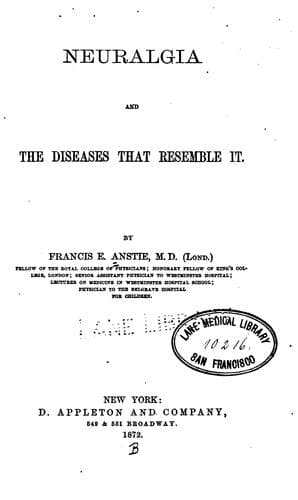
Neuralgia and the diseases that resemble itAnstie, Francis Edmund
Science
Neuralgia and the diseases that resemble it
Anstie, Francis Edmund
Neuralgia
neuralgic attack; one has been a sufferer from chorea; one has become
phthisical; one developed strumous disease, but has fairly recovered
from it. The remaining fifteen enjoy good health, but are distinguished,
almost without exception, by a markedly neurotic temperament, indicated
by an anxious tendency of mind, quickness of perception, æsthetic taste,
disposition to alternations of impulse and procrastination. Of the young
fifth generation growing up, there have been twenty-five children, of
whom only one has died (from fever), the rest are apparently healthy
(most of them specially so); but, as few have yet reached the age for
the development either of phthisis or of neurotic diseases, the future
of this generation can only be guessed at. [It is unnecessary to trace
the other descendants of the second generation, but I may state that
their medical history, also, strongly supports the theory of inheritance
of the neurotic tendency, and of the influence of an imported element of
phthisis in aggravating the latter.] I suspect that, as regards the
young children now growing up, everything will depend on the care with
which they are fed, and the kind of moral influences brought to bear on
them, two subjects which will be fully dwelt on in the chapter on
Treatment.
Of less perfect inquiries on the subject of neurotic disposition
inherited by neuralgic patients, I have made a great number, though I
regret to say that I have not attempted the task in the whole number of
those from whom I inquired as to direct inheritance of neuralgia from
their parents. However, in eighty-three cases this was done with all
possible care, and any deficiency of completeness in the results is not
my fault. I shall take first those that were private patients,
twenty-two in number, respecting whom, I may say, that the evidence is
of the best, as far as it goes, since I was better able to discriminate
as to the worth of statements, than in dealing with hospital patients,
and have rejected every case in which the informant did not seem
intelligent enough, or otherwise to have the means, to give a thoroughly
reliable account.
I. Neuralgia cervico-brachialis; in a lady, aged seventy-one.
Mother suffered from epileptiform facial tic; uncle was
paralyzed; patient herself eccentric to the verge of insanity.
II. Bilateral sciatica of great severity; in a gentleman, aged
seventy-three. Gout, paralysis, and neuralgia, have been
frequent in the family.
III. Cardiac neuralgia; in a man, aged twenty-four. Father epileptic
and a drinker; grandfather died of softening of the brain,
aged thirty-eight.
IV. "Cerebral" neuralgia; in a single lady, aged thirty-eight.
Mother has been insane; first cousin epileptic.
V. Lumbo-abdominal neuralgia; in a gentleman, aged fifty-two.
Father a drinker; mother insane; maternal grandfather
phthisical.
Public-domain text, read in full here on John Shaqi.
Reviews
Reviews
No reviews yet
Be the first to share your thoughts on this work.
Elsewhere in the archive
Join the Discussion
Join the discussion
Sign in to leave a comment or review.
Sign InorCreate an account