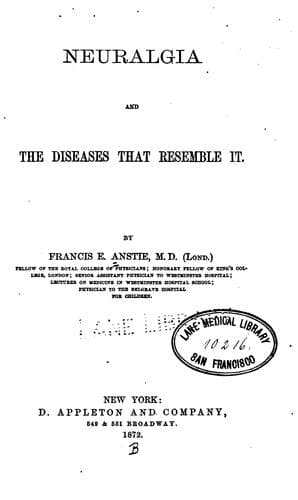
Neuralgia and the diseases that resemble itAnstie, Francis Edmund
Science
Neuralgia and the diseases that resemble it
Anstie, Francis Edmund
Neuralgia
This seems the fitting place to introduce some special remarks on
migraine in its relations to other neuralgias of the head, because
Eulenburg has mentioned and combated my view, according to which
migraine is a mere variety of neuralgia of the ophthalmic division of
the fifth nerve. I call it my view, because, though several other
authors had previously expressed it, I was first lead to entertain it by
observations made before I had studied their works, and especially by
the impressive teaching of my own case, as to which more will be
presently said. Eulenburg, though he fully allows that migraine is a
neuralgia, urges a series of objections to the identification of
migraine with ophthalmic neuralgias; of which objections one, based on
the doctrine of Du Bois Reymond as to the action of the sympathetic in
migraine, must be reserved for consideration when we discuss the general
pathology of the vaso-motor complications of neuralgia. The other
grounds of distinction that he urges are the following: In the first
place, he remarks that the site of the pain is by far less distinctly
referred to definite foci on the outside of the skull than in trigeminal
neuralgia; the patient's sensations very usually lead him to declare
that the pain is in the brain itself. Secondly, he says that the points
douloureux (in Valleix's sense) are almost constantly absent in true
migraine. Thirdly, he specifies the character of the pain in
migraine--dull, boring, straining, etc.--as differing from that of
trigeminal neuralgia, which is ordinarily much more acute and darting.
Fourthly, he notes the long duration of individual attacks of migraine,
and the long intervals (very commonly three or four weeks) between them.
Fifthly, he dwells on the frequent prodromata of migraine referable to
the organs of sense (flashes before the eyes, noises in the ears), or to
the stomach (nausea), or more generally to the reflex functions of the
medulla oblongata (_e. g._, convulsive rigors, excessive yawning, etc.)
Public-domain text, read in full here on John Shaqi.
Reviews
Reviews
No reviews yet
Be the first to share your thoughts on this work.
Elsewhere in the archive
Join the Discussion
Join the discussion
Sign in to leave a comment or review.
Sign InorCreate an account