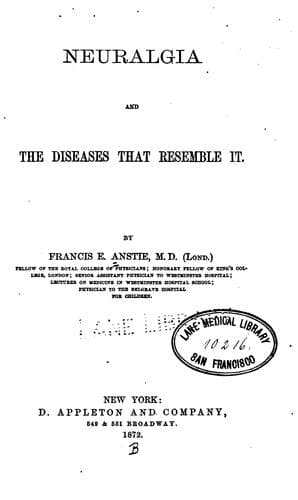
Neuralgia and the diseases that resemble itAnstie, Francis Edmund
Science
Neuralgia and the diseases that resemble it
Anstie, Francis Edmund
Neuralgia
It is far otherwise with the genito-urinary apparatus; in a large number
of cases, irritations proceeding from these organs do undoubtedly
contribute to the production of neuralgia, though by no means in the
important degree which many authors seem to have assumed. There can be
no doubt, for example, that the irritation of a calculus, either within
the kidney itself, in the ureter, or in the bladder, may set up violent
neuralgia, which for the most part is localized in the branches of the
lumbo-abdominal nerves. The instance of the eloquent Robert Hall is an
example of renal calculus acting in this way: he suffered the most
excruciating agony for years, and was obliged to take enormous
quantities of opium in order to make life endurable. An instance of
calculus impacted in the ureter, in a gentleman somewhat past middle
age, occurred in my own practice; the lumbo-abdominal neuralgia occurred
in frequent paroxysms of dreadful severity; and another case, already
referred to was that of a woman, in whom ovarian neuralgia was
undoubtedly in great part due to the irritation of an impacted calculus
in the ureter. These cases, however, are very rare in comparison with
others in which the peripheral source of the neuralgia is either the
uterus or ovary, or the external genitals. I have no means of
ascertaining, with anything like accuracy, the frequency with which the
internal sexual organs are the starting-point of neuralgia, because the
majority of such cases pass, naturally, to the care of physicians who
practice chiefly in the diseases of women, and consequently not
adequately represented either in my hospital or my private practice;
still, I have seen a good many of these affections, and, though I speak
with the reserve necessitated by the circumstances just named, I am much
inclined to believe that even such powerful centripetal influences as
those of the states of commencing puberty, of pregnancy, of the change
of life, and uterine diseases generally, are very rarely the cause of
true unilateral neuralgia, except in subjects with congenital tendencies
to neuralgia. But in predisposed subjects there can be no doubt that
these influences assist most powerfully in producing the malady.
Public-domain text, read in full here on John Shaqi.
Reviews
Reviews
No reviews yet
Be the first to share your thoughts on this work.
Elsewhere in the archive
Join the Discussion
Join the discussion
Sign in to leave a comment or review.
Sign InorCreate an account