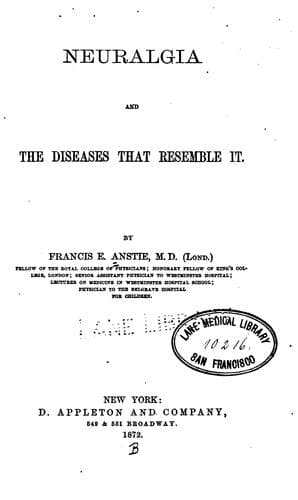
Neuralgia and the diseases that resemble itAnstie, Francis Edmund
Science
Neuralgia and the diseases that resemble it
Anstie, Francis Edmund
Neuralgia
Matilda W----, aged thirty-three, married, and has three very healthy
children. Comes of a remarkably healthy family, of which she told me the
entire history for three generations, with unusual intelligence and
clearness. No neuroses, properly so-called, in any of her relatives
during all this time. She herself was a very strong and hearty girl
until the age of seventeen; between this date and her marriage, three
years later, she was obliged to work tremendously hard at fine sewing,
by which means she gained a very scanty livelihood. After a
comparatively short period of this work she began to suffer from typical
attacks of migraine, very severe, and recurring every three or four
weeks, but in no particular connection with the menstrual function,
which was normal. On her marrying and ceasing to do needle-work, the
migraine entirely disappeared, and she retained perfect health till the
commencement of 1871. At this time she had suckled a very hearty baby
for ten months, and was not able to furnish such good living as usual.
She was attacked early in January, with violent neuralgia affecting all
three branches of the right fifth, and she the more readily applied for
advice because she soon found that the neuralgia was becoming
complicated with dimness of vision in the eye of the affected side, "as
if she was going to have a cast." Was quite unconscious of ever having
had syphilis. The medical man encouraged to believe that the whole
malady was nervous, and would soon disappear under appropriate remedies,
and gave her quinine, under which treatment she declares that she was
rapidly improving, both as to pain and vision, but that her resources
came to an end, and she could no longer pay for the medicine. She then
neglected herself, and rapidly got worse in all regards, till at last
she was compelled to apply to the South London Ophthalmic Hospital,
whence Mr. Carter sent her to me, on the 6th of April. At this time the
paroxysms were excessively violent and frequent, though brief. On
examination, tender points were found at the supra-orbital notch, at the
infra-orbital foramen; in front of the ear; in the temporal region; in
the parietal region, and the inferior dental region. There was strongly
marked anæsthesia of the skin of the right half of the face, of the
gums, and of the side of the tongue. The teeth were absolutely perfect:
not one spot of caries could be seen. Taste was completely destroyed in
left half of anterior part of the tongue. Smell was totally lost on both
sides, and had been so, the woman declared, from a very early period in
the illness. The right eye showed complete paralysis of the levator
palpebræ and of the external rectus; nearly complete paralysis of the
superior and inferior rectus, rather less marked paralysis of the
internal rectus. Pupil normal, conjunctiva moderately congested,
lachrymation profuse, photophobia partial. The functions of the retina
were perfect. Accommodation was affected in the following degree and
Public-domain text, read in full here on John Shaqi.
Reviews
Reviews
No reviews yet
Be the first to share your thoughts on this work.
Elsewhere in the archive
Join the Discussion
Join the discussion
Sign in to leave a comment or review.
Sign InorCreate an account