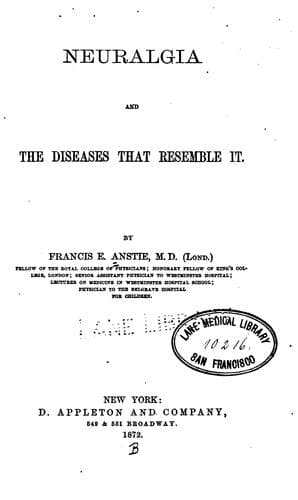
Neuralgia and the diseases that resemble itAnstie, Francis Edmund
Science
Neuralgia and the diseases that resemble it
Anstie, Francis Edmund
Neuralgia
It is necessary to go over again the proof of these facts; they are
given pretty copiously in the chapter on Complications; and could have
been made much more numerous. But the point to which I desire to compel
the reader's attention is the impossibility as it seems of me, of
accounting for the variety and complexity of these phenomena, except by
the supposition that there is in every case of neuralgia a central
change, which is the one most important factor in the producing both of
the pain and of the secondary phenomena. For the result of my experience
is that neuralgia, unless very slight and brief, is never unattended by
these complications and in the great majority of cases involves several
different secondary alterations of function which must (so to speak)
radiate from the central end of the sensory nerve, and from no other
place whatever. And it must be remembered that the most elaborate
"_symptome-complexe_" is found equally in cases where no suggestion of
any peripheral origin of the pain can be made, and in cases where, at
first sight, one might fancy there was a very obvious peripheral cause
for pain. I am quite willing to admit, with Eulenburg and others, that
the evidence, powerful and varied though it be of the relations of
neuralgia to hereditary neuroses, to alcoholic and senile degeneration,
etc., only raises a strong probability that some part of the central
nervous system is the _locus in quo_ of the essential morbid processes
in the majority of neuralgias. But the case stands far otherwise now
that we are able to show, not merely that the majority of neuralgic
patients suffer from such influences as those above mentioned, but that
every variety of neuralgia is liable to be complicated with secondary
affections of the most divergent nerves, the only common meeting-place
of which is in the spinal centre of the painful nerve; and when we find
moreover, that many of these secondary affections can equally be
produced by undoubted atrophic changes (as in ataxy of those same
posterior roots).
Public-domain text, read in full here on John Shaqi.
Reviews
Reviews
No reviews yet
Be the first to share your thoughts on this work.
Elsewhere in the archive
Join the Discussion
Join the discussion
Sign in to leave a comment or review.
Sign InorCreate an account