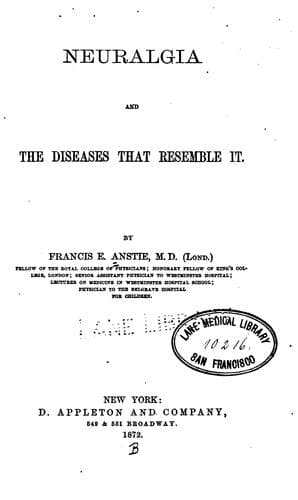
Neuralgia and the diseases that resemble itAnstie, Francis Edmund
Science
Neuralgia and the diseases that resemble it
Anstie, Francis Edmund
Neuralgia
But, if the combination of several such centripetal influences may
generate the neurosis unaided, even a single one of them operating
powerfully for a long period may produce most serious consequences in
those who are hereditarily predisposed. The influence of prolonged
fatigue of the eyesight, independently of any special intellectual or
emotional strain, was strongly illustrated in my own case about three
years ago. I was then engaged upon a piece of scientific writing which
demanded no great intellectual effort, but was being done against time,
and by working, night after night, many hours by gas-light. My neuralgic
(trigeminal) attacks came on with great severity, accompanied by
vertiginous sensations of so alarming a kind as to make me fear the
invasion of some serious brain-mischief. I broke off all work, and went
to the sea-side, but was greatly disappointed to find, for the first few
days, that the symptoms were not in the least mitigated. The mystery was
soon explained. The weather had been such as to confine me a good deal
to the house, and, thinking it would do no harm, I amused myself with
reading newspapers and novels. At last I suspected that the use of my
eyes in reading was altogether mischievous; I desisted from reading any
thing, and in forty-eight hours every symptom had vanished.
Among peripheral influences of a more mechanical kind there is one cause
of neuralgia, the force of which has been variously estimated, but which
some authors rate as very important, viz.: the influence of the
pressure, and especially of the varying pressure, of blood-vessels, or
other hollow viscera, upon the trunks of the nerves. We must set aside
one such action which is undoubtedly very powerful, as essentially
differing from the others; I mean the pressure of dilated blood-vessels,
especially aneurisms, when this happens to be exerted upon the ganglion
of the sensory trunk. Here there can be no doubt of the mischief; for
the pressure, if at all severe, gradually destroys the life of the
ganglion, upon which, as was proved by Waller, the nutrition of the
posterior nerve-root hangs with very intimate dependence, and the
pulsations of the vessel seem greatly to aggravate both the irritation
and the centripetal tendency to atrophy. In short, it is plain that such
lesion of a ganglion may be the whole and sufficient cause of a
neuralgia of the most desperate and incurable kind. It is another matter
when we are asked to believe that the mere varying pressure of
intestines, in different states of fullness, or plexuses of pelvic veins
liable to temporary congestions, can so affect the sciatic nerves as to
set up neuralgia. Considering the extreme frequency of cases in which
such momenta must be partially coming into operation, especially in
women--a frequency altogether out of proportion to that of sciatica--I
cannot admit the probability that this influence is more than an
occasional and very secondary factor, and that only in cases where the
Public-domain text, read in full here on John Shaqi.
Reviews
Reviews
No reviews yet
Be the first to share your thoughts on this work.
Elsewhere in the archive
Join the Discussion
Join the discussion
Sign in to leave a comment or review.
Sign InorCreate an account