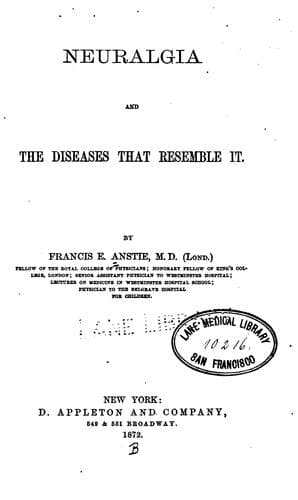
Neuralgia and the diseases that resemble itAnstie, Francis Edmund
Science
Neuralgia and the diseases that resemble it
Anstie, Francis Edmund
Neuralgia
That neuralgic patients require and are greatly benefited by a nutrition
considerably richer than that which is needed by healthy persons, is a
fact which corresponds with what may be observed respecting the chronic
neuroses in general; and it gives me much satisfaction to point out this
position of neuralgia as belonging to this large class of disorders, not
merely by its pathological affinities, but by its nutritive demands. In
a very excellent and suggestive paper by Dr. Blandford[36] it is stated,
as the result of a large experience in mental and other nervous
disorders, that the greater number of chronic insane and hypochondriacal
cases, as well as neuralgic patients, are remarkably benefited by what
might seem at first sight almost a dangerously copious diet.
Occasionally it happens that the patients discover this by the teaching
of their own sensations, and the apparent excesses in eating which some
epileptic and hypochondriacal persons habitually commit are looked on by
many practitioners as the mere indications of a morbid _bulimia_ which
represents no real want, but only the craving of a perverted sensation
which ought to be interfered with and allayed rather than encouraged. It
is now many years since I began to doubt the justice of this opinion;
the particular instance which called my attention to it being that of
epilepsy, of which disease I saw a considerable number of cases, within
a short period of time, that were distinguished by the presence of
enormous appetite for food; and I finally came to the conclusion that,
so far from this symptom being of evil augury, and likely to lead to
mischief, it is, with certain limitations, a most fortunate occurrence.
It is hardly necessary to say that over-eating, such as produces
dyspepsia and distention of a torpid intestine with masses of fæces, may
distinctly aggravate the convulsive tendency; but the truth is that,
with a little careful direction and management of the unusual appetite,
these bulimic patients can in most cases be allowed to satisfy their
desires without harm of this kind following; a larger portion of food
really gets applied to the nutritive needs of the body, and the nervous
system unmistakably benefits thereby, the tendency to atactic disorder
being visibly held in check.
Public-domain text, read in full here on John Shaqi.
Reviews
Reviews
No reviews yet
Be the first to share your thoughts on this work.
Elsewhere in the archive
Join the Discussion
Join the discussion
Sign in to leave a comment or review.
Sign InorCreate an account