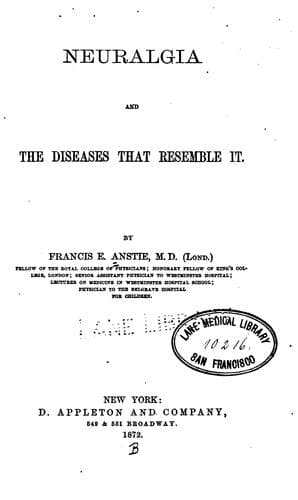
Neuralgia and the diseases that resemble itAnstie, Francis Edmund
Science
Neuralgia and the diseases that resemble it
Anstie, Francis Edmund
Neuralgia
A milder, but still very useful form of the same kind of action, is
produced by veratrine-ointment. I would recommend, however, as a rule,
that it be employed, at any rate at first, of weaker strength than that
recommended in the Pharmacopoeia, for with some persons it is easy to
pass the anæsthetic, and to enter on the irritant, action of veratrine
upon the skin. This leads me to give a caution that should properly
have come earlier, when I was speaking of skin-stimulants. In aged
subjects, especially, we rather frequently meet, in neuralgia, with a
specially irritable state of the skin, even although there may be at the
same time some loss of common and tactile sensation; and the
practitioner must be warned against the danger of producing an amount of
skin-irritation which will fearfully annoy his patient. I speak
feelingly, having by such an indiscretion lost the richest patient who
ever favored my consulting-room with his presence!
The inunction of mild veratrine-ointment is extremely useful, as an
adjunct to other treatment, in migraine and supra-orbital neuralgias of
suckling women, and of chlorotic girls. I have also seen it do much good
in mammary neuralgia.
The last division of the subject of paralyzing agents in the treatment
of neuralgia includes the surgical operations for division or resection
of a painful nerve. Upon this question there is much difficulty in
speaking decidedly. I admit at once, of course, that surgical
interference is evidently indicated when, along with decided and
intractable neuralgic pain, there is plain evidence either of the
existence of a neuromatous tumor, or the presence of a foreign body
impacted, or a tight cicatrix pressing upon a nerve. I admit, also,
though with much greater qualifications, that carious teeth may need to
be extracted before we can cure a neuralgia; but even here I should put
in the decided caveat that we must consider whether the system is in a
state to bear the shock, and that in any case we probably ought to
mitigate the effects of the operation by performing it under chloroform.
And I need hardly tell any one, who is familiar, either practically or
from reading, with the subject, that thousands of carious teeth have
been extracted from the mouths of neuralgic patients, not only without
benefit, but with the effect of distinctly aggravating the disease. And
I am yet more doubtful as to the advisability of such surgical
procedures as the division or the resection of a piece of the painful
nerve. Theoretically, as the reader will understand from the strong
opinion I have given as to the mainly central origin of neuralgias, I
never could anticipate that such a procedure would be more than
temporarily successful; on the contrary, the mischief in the central end
of the nerve remaining, I should suppose that the trying process of the
reunion of the nerve (which always takes place) would be almost
certainly attended with a revival of the neuralgia, too probably in an
aggravated form.
Public-domain text, read in full here on John Shaqi.
Reviews
Reviews
No reviews yet
Be the first to share your thoughts on this work.
Elsewhere in the archive
Join the Discussion
Join the discussion
Sign in to leave a comment or review.
Sign InorCreate an account