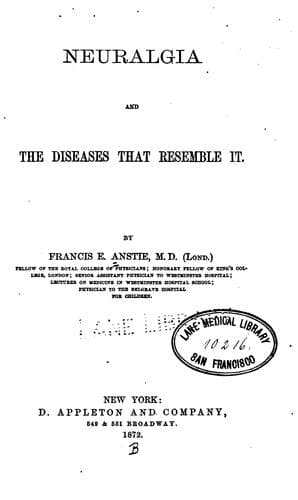
Neuralgia and the diseases that resemble itAnstie, Francis Edmund
Science
Neuralgia and the diseases that resemble it
Anstie, Francis Edmund
Neuralgia
On the effect of frictional electricity I have had such very small
experience that I cannot venture to speak with any confidence, and the
accounts that I have heard from others whose experience is much larger
have not led me to attribute much importance to this agent. If I am to
judge at all, I should say it merely acts as a skin-stimulant, and is,
in that capacity, inferior to many other simpler and more facile
applications.
Very different is the verdict of experience as regards the effects of
the constant current; here the results which I have obtained have been
so remarkable that even now I should distrust their accuracy, were it
not that they are in accord with the general result which (among minor
discrepancies) may be gathered, we may fairly say, from all the more
important researches that have lately been carried out in Germany. The
constant current, as I now estimate it, is a remedy for neuralgia
unapproached in power by any other, save only blistering and hypodermic
morphia, and even the latter is often surpassed by it in permanence of
affect; while it is also applicable in not a few cases where blistering
would be useless or worse.
The English medical profession has not as yet adequately appreciated the
necessity for great care in the choice of apparatus and the mode of
application of electricity. It is all-important, however, and especially
in the case of applying galvanism for the relief of pain. The first
quality that must be absolutely required in a battery, that is to be
used for this purpose, is that it shall deliver its current with as
little as possible variation of tension, in fact that it shall be
constant, and not merely continuous; a vast majority of all the various
galvanic apparatus that have been used have been merely the latter, and
have consequently been almost valueless for the relief of pain. Such are
Pulvermacher's chains, the voltaic piles made with elements of metallic
gauze, Cruickshank's battery, and many others that have been used. A
sufficiently constant current may be obtained from either of the
following apparatuses, (1) Daniell's battery, (2) Bunsen's, (3) Smee's.
For hospital use, the Daniell battery (in Muirhead's modification, or
with the form of cells introduced by Siemens-Halske) is perhaps the most
desirable; but for private practice it is worth while to sacrifice
something of the superior constancy which we gain in the Daniell battery
for the sake of comparative portability. All purposes which we aim at in
the electric treatment of neuralgia may be sufficiently obtained by the
use either of the Bunsen battery (zinc-carbon, excited by dilute
sulphuric acid), as modified by Stohrer, or by the Smee battery (zinc
and platinized silver, excited by dilute sulphuric acid), as in the
highly convenient apparatus devised by Mr. Foveaux, of Weiss & Son's. It
must be remarked that, for the purpose of treating neuralgia, we shall
never need to employ more than fifteen, or at the utmost twenty, cells
Public-domain text, read in full here on John Shaqi.
Reviews
Reviews
No reviews yet
Be the first to share your thoughts on this work.
Elsewhere in the archive
Join the Discussion
Join the discussion
Sign in to leave a comment or review.
Sign InorCreate an account