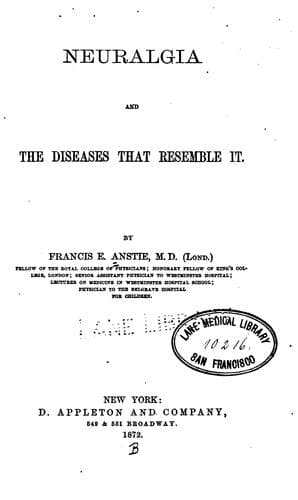
Neuralgia and the diseases that resemble itAnstie, Francis Edmund
Science
Neuralgia and the diseases that resemble it
Anstie, Francis Edmund
Neuralgia
of the painless constant current; and such facts have now been recorded,
in multitudes, by most competent observers.
The next maxim of first-rate importance is that the applications of the
current should be made at regular intervals, and at least once daily; in
most instances, this is enough, but occasionally it will be found useful
to operate twice in the day. The matter of regularity is, I find, of
great consequence, and it will not do to intermit the galvanism
immediately on the occurrence of a break in the neuralgic attacks: it
should be continued for some days longer.
The length of sittings is a point as to which there is considerable
difference of opinion between various authorities; but my own
experience coincides with that of Eulenburg, that from five to ten, or,
at the utmost, fifteen minutes, is almost the range of time.
Closely connected with the question of the length of sittings, is that
of the continuity with which the current is to be applied. I have seen
the best results, on the whole, from passing a weak current, without any
breaks, for about five minutes. But, where there are several foci of
intense pain, it will often be advisable to apply the current to each of
these, successively, for three or four minutes.
The places to which the electrodes should be applied vary much according
to the nature of the case.
Benedikt's rule, that the application of electricity, to be useful, must
be made to the seat of the disease, is undoubtedly true; but it is
capable of being applied in a somewhat different manner from that which
he recommends in particular cases, the difference being due to the view
of the pathology of neuralgia which is taken in this work. That view is,
that the essential _locus morbi_ is always in the posterior nerve-root
(and usually in that portion of the root which is within the substance
of the cord), and that the peripheral source of irritation, if any, is
only of secondary--though sometimes of considerable--importance. Hence
the main object, in electrization, would seem to be to direct the
influence of the current upon the posterior nerve-root. This may,
however, be done in different ways, according to the situations in which
we place the electrodes, and the direction in which we send the current.
Public-domain text, read in full here on John Shaqi.
Reviews
Reviews
No reviews yet
Be the first to share your thoughts on this work.
Elsewhere in the archive
Join the Discussion
Join the discussion
Sign in to leave a comment or review.
Sign InorCreate an account