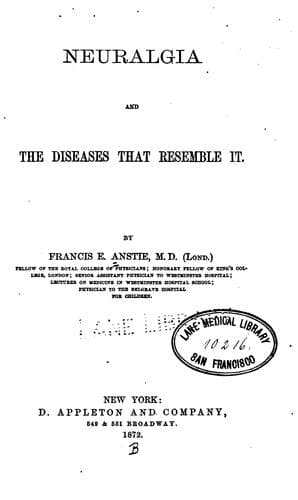
Neuralgia and the diseases that resemble itAnstie, Francis Edmund
Science
Neuralgia and the diseases that resemble it
Anstie, Francis Edmund
Neuralgia
On the contrary, we sometimes see complete failure of the current to
affect any good whatever; and in these cases the reversal of the current
has not, so far, appeared to me to make any particular change in the
result. Such was the case with a patient whose history I detailed (along
with that of Case I.) to the Clinical Society. She was an ill-fed and
overworked unmarried needle woman, aged thirty; the neuralgia was a most
violent double occipital pain, with foci, on each side, where the great
occipital nerves become superficial. The current was passed daily, for
some days, from one focus to another (necessarily passing through the
nerve-roots and the spinal cord), and the positions of the conductors
were occasionally reversed; this not succeeding, the current was applied
altogether to the spine, the negative pole being placed on the highest
cervical vertebræ, but no good effect was produced after a treatment,
altogether, of sixteen days.
Notwithstanding these, and a good many similar facts that could be
adduced, I should hesitate to go so far as to say that there is never
any importance in the direction of the current. In old-standing cases,
where there are well-marked _points douloureux_ that are exceedingly
sensitive, I have found that the application of the positive pole,
successively, on the most tender points, the negative being placed on
the spine opposite the point of origin of the nerve, has had a more
beneficial effect than any other mode of application.
There are very considerable differences, both as to the best manner of
galvanization, and also as to the chances of doing good with it, in the
case of neuralgias of different nerves; and, on the whole, I find
Eulenburg's conclusions on this matter very just. He indicates sciatica
as the affection which is by far the most curable by the constant
current; he says that many cases are cured in from three to five
sittings, while others require as many weeks, or even months of
treatment; and that a total absence of benefit is only seen in rare
cases dependent on central causes, or on diseases which are irremovable
(like malignant pelvic tumors). On the other hand, he reports that
intercostal neuralgia has never been materially benefited by
galvanization in his hands. With regard to ordinary trigeminal
neuralgias, he speaks strongly of the current as a palliative, but very
doubtfully of its power to cure, in genuine and severe cases. In
cervico-brachial neuralgia he speaks of it as dividing with hypodermic
morphia the whole field of useful treatment, in the majority of cases.
In cervico-occipital neuralgia he says it rarely does much good. I shall
return to Eulenburg's estimate of its utility in migraine, presently.
Let me here say that I am inclined to indorse everything in the
above-detailed statements, excepting that I should place a considerably
higher estimate on the curative powers of the current in ordinary
trigeminal neuralgias. The remedy, like every other, will doubtless fail
Public-domain text, read in full here on John Shaqi.
Reviews
Reviews
No reviews yet
Be the first to share your thoughts on this work.
Elsewhere in the archive
Join the Discussion
Join the discussion
Sign in to leave a comment or review.
Sign InorCreate an account