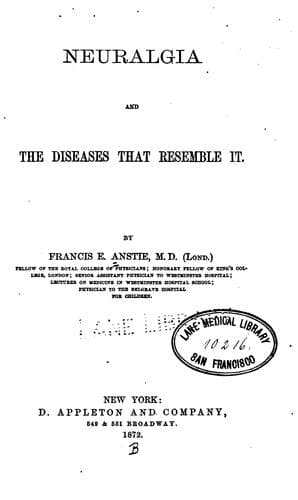
Neuralgia and the diseases that resemble itAnstie, Francis Edmund
Science
Neuralgia and the diseases that resemble it
Anstie, Francis Edmund
Neuralgia
We shall best commence the inquiry by directing our attention once more
to the fact, so often insisted upon in this work, that the large
majority of neuralgic patients carry in them the seeds of their malady
from their birth. It has been amply proved that every child born of a
family that has shown strong tendencies to insanity, epilepsy,
paralysis, etc., etc., ought to be looked on as a neurotic subject, and
as a potential sufferer from neuralgia. It has been shown that such
children will be exposed, even under favoring external circumstances, to
the danger of neuralgia at certain important stages of their
physiological history. The earliest of these critical periods is marked
by the occurrence of puberty; and it is not till this time that
psychical influences, as such, come to have any serious bearing on the
formation of the neuralgic habit. Mischief may, indeed, be done to the
brain and the general nervous system, by injudicious mental training, at
a far earlier period; but this mischief, serious or even fatal as it may
be, usually takes some other form than that of neuralgia. It will be
necessary, here, to reflect a little upon certain features of the
childish mind, in order that we may rightly estimate the kind of
influence which puberty exerts upon it.
A very young child is selfish, in the purely animal sense; it is
greedily acquisitive, and its selfishness is unchecked by any sense of
shame. With later childhood there comes a sense of right and wrong, and
a sensitiveness to shame, which check this tendency; still it is the
exception rather than the rule to find any great capacity of
self-abnegation in young school-boys. But a moderately healthy-minded
child, up to the age of puberty, is only acquisitively selfish; he is
not self-centered in the sense of dwelling upon his own mental state,
and reflecting upon the nature of his motives and feelings. It is with
the age of puberty that self-consciousness begins to be a feature in the
mind of the young, and its appearance marks the entrance of a dangerous
element into the character. It is an inevitable stage in mental growth,
and, if wisely dealt with, is ultimately productive, not of evil, but of
good; but it is more perilous to some children than to others, and it is
especially fraught with danger to those whose nervous centres are, by
inheritance, weak and unstable in whole or in parts. The mental antidote
to its possible evil effects is to be found in a vigorous (but not
excessive) training of the mind in studies which shall be as far as
possible external, and the discouragement of all tendencies to
introspection. I would venture to express the decided opinion that the
common idea, that close study injures the young, is only true in a
modified sense. It is, however, unquestionably the fact, that hasty and
imperfect cram-work does very seriously impair the stability of the
brain and the nervous system in young people; there is a spurious
Public-domain text, read in full here on John Shaqi.
Reviews
Reviews
No reviews yet
Be the first to share your thoughts on this work.
Elsewhere in the archive
Join the Discussion
Join the discussion
Sign in to leave a comment or review.
Sign InorCreate an account