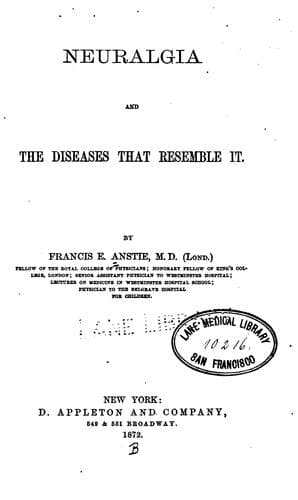
Neuralgia and the diseases that resemble itAnstie, Francis Edmund
Science
Neuralgia and the diseases that resemble it
Anstie, Francis Edmund
Neuralgia
In the present transitional state of opinion concerning the mode in
which the phenomena are produced that are popularly known under the name
of "reflex paralysis," I cannot pass without notice the doctrines of
these two observers. The reader will have perceived that, as regards the
secondary paralytic symptoms observed in neuralgias, I explain the
phenomena mainly on the theory of a process which is central, and not
peripheral, in origin. And, even where, as in some few instances, it
seems possible that the starting-point was an organic affection of some
viscus, we must always consider the possibility that the link between
this and the neuralgia and paralyses was a neuritis migrans travelling
inward to the sensory centre, and from that passing over to motor
centres and thus producing paralysis; or that, without the intervention
of any truly inflammatory process, the continual impressions streaming
in upon the cord from the original seat of organic disease may damage
the nutrition of the sensory nerve-root, producing a partial atrophy,
and that this process may extend to the motor root.
It remains, however, to inquire whether the influence of powerful
peripheral agencies may not, in a purely "functional" manner, disable
the nerve-centres for a time, causing paralysis with or without
neuralgia. The main supporters of such a doctrine are Dr. Handfield
Jones[46] and M. Jaccoud.[47]
Dr. Handfield Jones expressly rejects the theory of Brown-Sequard, as to
spasm of the vessels in the nerve-centres, and we need not repeat his
arguments on that head, because it seems to be generally felt that the
vascular spasm theory will not account for the facts. Jones believes
that the state produced in the nerve-centre by the peripheral influence
is one of paresis from shock-depression, and that from the sensory
centre this state can communicate itself to motor and vaso-motor
centres, though commissural fibres. He does not believe in the existence
of a special inhibitory portion of the nervous system: he believes that
an impression may prove stimulating when it is mild, or paralyzing when
it is strong; and that any afferent nerve may convey either the one
influence or the other to the centres and thus produce secondary
stimulus or secondary paralyses in various efferent nerves. Jones has
the distinguished merit of being one of the first authors distinctly to
perceive that pain must rank on the same level with paralysis: hence he
sees nothing unintelligible in the communication of paralysis to a motor
centre from a sensory centre that was in the state which the mind
interprets as pain.
Public-domain text, read in full here on John Shaqi.
Reviews
Reviews
No reviews yet
Be the first to share your thoughts on this work.
Elsewhere in the archive
Join the Discussion
Join the discussion
Sign in to leave a comment or review.
Sign InorCreate an account