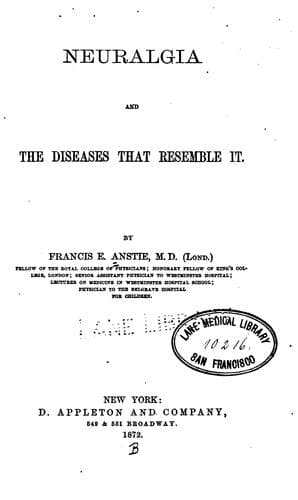
Neuralgia and the diseases that resemble itAnstie, Francis Edmund
Science
Neuralgia and the diseases that resemble it
Anstie, Francis Edmund
Neuralgia
The first example was that of a medical man, aged seventy-five, in whom
a neuralgia, originally malarial in origin, and of some years' duration,
had fixed itself for some time in the fifth and sixth left intercostal
spaces, and of late had become complicated with anginoid attacks of an
unmistakable character, though not of the highest degree of severity.
The case certainly seemed very unpromising, looking at the patient's age
and the consequent high probability that there was much arterial
degeneration. However, the use of Fowler's solution (five minims three
times a day) was commenced and steadily pushed. The anginoid attacks
rapidly diminished in frequency and at the end of ten days' time were
entirely gone, and after one month of treatment he still had no return
of them, although they had previously been of daily occurrence. It is a
curious fact, whether a mere coincidence or not I cannot say, that, some
few days after the anginoid attacks ceased, he began to experience
somewhat severe pains, rheumatic in feeling, but unattended with heat or
swelling, in the elbows, wrists, and fingers, symmetrically. This has
nearly disappeared, but he is still free from angina. There is no
discoverable heart-lesion in this patient.
The other case was that of a fine old man of sixty-four, who, but for
some few slight attacks of gout, a few small calculi, and a troublesome
prostatic affection, had always enjoyed remarkably good health, until
about five months ago, when he began to notice tightness across the
chest, etc., when he walked uphill. About a fortnight before he came to
me, he was seized with very violent and alarming paroxysms of pain
across the chest and running down both arms, extreme intermittence
of pulse, and a sense of impending dissolution. The attack had recurred
daily, at the same hour (6 P. M.), ever since; besides which there was
an abiding sense of uneasiness in the cardiac region, and a
consciousness that the least excitement or exertion would bring on the
paroxysm. I put the patient on five minims of Fowler, three times a day,
with directions to take ether when the paroxysms came. At the end of the
first week there was already much improvement, the paroxysms having been
both less frequent and less severe. At the end of a fortnight's
treatment he reported that there had been nothing like a paroxysm for
the last eight days, although there was still a good deal of uneasiness
from time to time. The hour at which the attack was expected passed by
absolutely without a trace of angina. It remains to be seen how long
this improvement will last, but the altered state of things, and
particularly the suddenness of the change, cannot be overlooked, and has
very much struck the patient himself. It is now six weeks since he had
any paroxysm.
Public-domain text, read in full here on John Shaqi.
Reviews
Reviews
No reviews yet
Be the first to share your thoughts on this work.
Elsewhere in the archive
Join the Discussion
Join the discussion
Sign in to leave a comment or review.
Sign InorCreate an account