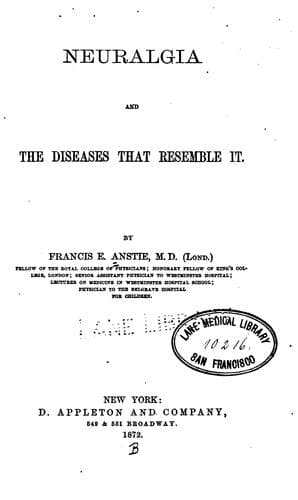
Neuralgia and the diseases that resemble itAnstie, Francis Edmund
Science
Neuralgia and the diseases that resemble it
Anstie, Francis Edmund
Neuralgia
Of all the diseases which superficially resemble neuralgia, none are so
likely to be confounded with it, on a cursory glance, as myalgia. More
careful inquiry, however, furnishes, in nearly all cases, ample means
for distinguishing between the two affections.
Myalgia is an exceedingly painful affection, and it is also much more
common than was formerly supposed. It is to Dr. Inman that we
undoubtedly owe the demonstration of the frequent occurrence of this
malady, and the facility with which it may be mistaken for other, and
sometimes much more serious, diseases, with very disastrous results. At
the same time, I must express the opinion that this ingenious author has
decidedly exaggerated the importance of this local disease at the
expense of an unjust depreciation of the frequency and significance of
other painful disorders which have their origin within the nervous
system.
Myalgia proper includes all those affections which are severally known
as "muscular rheumatism" (for the muscles generally), and "lumbago,"
"pleurodynia," etc. (according to locality). It is essentially pain
produced in a muscle obliged to work when its structure is imperfectly
nourished or impaired by disease.
The clinical history of the different varieties of myalgia absolutely
requires this key for its interpretation; otherwise, the appearance of
the sufferers from different kinds of myalgia is so widely dissimilar
that we should be exceedingly likely to miss the important features of
treatment, which must be applied to them all in common. Nothing, for
instance, can be more strikingly unlike than the appearance of the
pallid, stunted, under-nourishment cobbler who complains of epigastric
myalgia, and that of the ruddy and muscular navvy who suffers from acute
lumbago, or the similarly plethoric-looking country commercial
traveller, who has been driving in his gig against wind and rain, and
complains of violent aching pains in one or both shoulders; yet one and
all of these individuals are suffering from precisely the same cause of
pain, viz., a temporarily crippled muscle or set of muscles which has
been compelled to work against the grain. Why this state of things
should invariably be interpreted as sensation in the form of acute pain
never absent, but severely aggravated by every movement of the affected
part, is a matter beyond our powers of explanation, we must accept it as
an ultimate fact for the present.
Public-domain text, read in full here on John Shaqi.
Reviews
Reviews
No reviews yet
Be the first to share your thoughts on this work.
Elsewhere in the archive
Join the Discussion
Join the discussion
Sign in to leave a comment or review.
Sign InorCreate an account