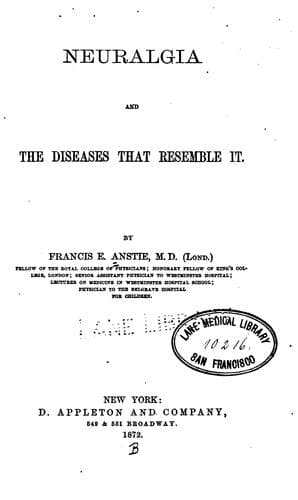
Neuralgia and the diseases that resemble itAnstie, Francis Edmund
Science
Neuralgia and the diseases that resemble it
Anstie, Francis Edmund
Neuralgia
There is no need to dilate at greater length upon the varieties in the
symptoms of myalgia, according as it affects one or another part of the
body. We must consider, briefly the different kinds of cause that
produce it. The immediate source of the pain being, as we have seen, the
sense of embarrassment in a muscle obliged to contract when unfit for
the work, we have to ask what are the remoter causes that can produce
this special unfitness for the work of contraction. They are three:
(_a_) Overlabor pure and simple (_i. e._, in proportion to the existing
bulk and quality of the muscle); (_b_) cold, and especially damp cold,
producing a semi-paralyzing effect on the vaso-motor nerves, and causing
congestion and sometimes a little effusion among the fibres or within
the sheath of the muscle; (_c_) fatty degeneration of muscle which is
exposed to inevitable and incessant work. Either of these conditions may
so disable the muscle that its unavoidable contractions will set up the
myalgic state.
Undoubtedly however there is something further, in the shape of a
natural predisposition not yet understood, which makes some patients so
much more liable to suffer myalgic pain as a consequence of this sort of
influences than other persons are. I am in no condition to decide what
the nature of this predisposition is; I feel sure it is heightened by an
inherited or acquired gouty taint, but I have seen it in people whom
there is no reason to suspect of gouty tendencies. It appears to have no
connection with true rheumatism.
Still after all that can be said, myalgia remains a disease chiefly of
local origin, and depending for nine-tenths of its causation upon a
derangement between the balance of work and nutrition in the muscle.
As regards the diagnosis of myalgia from neuralgia, which is a very
important matter, the following are the main points that we should
recollect:
_Neuralgia._ _Myalgia._
Follows the distribution of a Attacks a limited patch or
recognizable nerve or nerves. patches that can be identified
with the tendon or aponeurosis
of a muscle which, on inquiry,
will be found to have been hardly
worked.
Goes along with an inherited or As often as not occurs in persons
acquired nervous temperament, with no special neurotic
which is obvious. tendency.
Is much less aggravated, Is inevitably, and very severely,
usually, by movement than aggravated by every movement of
myalgia is. the part.
Is at first accompanied by no Distinguished from the first, by
local tenderness. localized tenderness on pressure
as well as on movement.
Public-domain text, read in full here on John Shaqi.
Reviews
Reviews
No reviews yet
Be the first to share your thoughts on this work.
Elsewhere in the archive
Join the Discussion
Join the discussion
Sign in to leave a comment or review.
Sign InorCreate an account