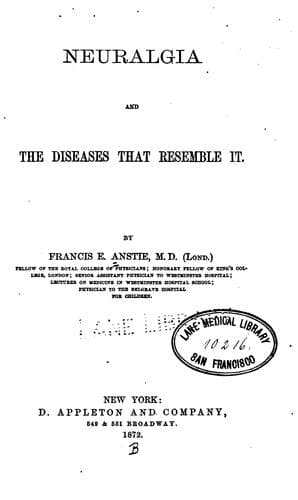
Neuralgia and the diseases that resemble itAnstie, Francis Edmund
Science
Neuralgia and the diseases that resemble it
Anstie, Francis Edmund
Neuralgia
The fact that Faradization proves so remarkably useful, in these cases
of spinal irritation with diffuse cutaneous or mucous tenderness, is in
itself a strong diagnostic between this sort of affection and the true
neuralgiæ, which, as I have stated are seldom benefited, and are often
made worse, by the interrupted current, though the constant current
frequently mitigates or cures them.
Sometimes where it is not possible to apply the remedy directly to the
sensitive surface, we may nevertheless do great good by sending the
interrupted current through it. Thus, in gastric sensitiveness connected
with spinal tenderness in the upper dorsal region, I have seen very
great relief afforded by sending a current from the positive pole,
placed on the tender vertebræ, to a broad, negative conductor placed on
the epigastrium. And similarly, I have seen an acutely sensitive
condition of the neck of the bladder greatly soothed by the passage of a
current from a painful lumbar vertebra to the perinæum immediately
behind the scrotum.
Undoubtedly, however, the more serious cases of spinal irritation will
yield only (if they yield at all) to a prolonged treatment in which very
skilful use is made of general hygienic measures, and especially of
morbal influences. As the brothers Griffin long ago pointed out,
although rest is useful in the early stages of this malady, if the
disease does not quickly yield to this and to appropriate tonic
medication, and perhaps local applications to the spine, it will not do
to keep the patient recumbent and confined to the house; on the contrary
at whatever cost of immediate discomfort, he (or she for these patients
are by far the most frequently females) must be roused up, and persuaded
or compelled to take out-door exercise, and if possible to travel, and
divert the mind by complete change of scene. When such expensive
remedies are out of the question, it seems better that patients, even
seemingly very feeble, should take to their ordinary avocations in life
again, and fight down the tendency to invalidism. But of course, the
decision on such a point must rest with the tact and judgment of the
practitioner in each individual case, for there are, doubtless,
instances in which the attempt to carry out such a plan, even
moderately, would break down the remaining strength, and make matters
worse than they were before.
Public-domain text, read in full here on John Shaqi.
Reviews
Reviews
No reviews yet
Be the first to share your thoughts on this work.
Elsewhere in the archive
Join the Discussion
Join the discussion
Sign in to leave a comment or review.
Sign InorCreate an account