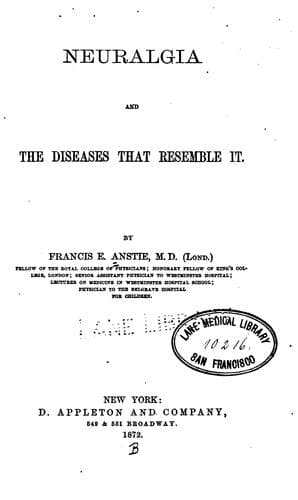
Neuralgia and the diseases that resemble itAnstie, Francis Edmund
Science
Neuralgia and the diseases that resemble it
Anstie, Francis Edmund
Neuralgia
The only case of cerebral abscess that I have personally seen, in which
the above points of distinction would have been insufficient, was that
of a boy of sixteen, in whom the only discoverable symptom, for nearly
three months, was pain, very strongly resembling ordinary migraine,
recurring not oftener than once in ten days or a fortnight, lasting for
some hours at a time, and nearly always ending in vomiting, and
disappearing after sleep. At the end of the three months, acute pain in
the left ear set in, and this was followed, soon, by right hemiplegia,
coma, and death. It was then discovered, although it had formerly been
denied, that the boy had suffered from discharge from the left ear,
following a febrile attack which had been marked by sore-throat, and
followed by desquamation of the cuticle--evidently scarlet fever. In all
cases of severe pain in the head, it is a golden rule to inquire most
carefully as to the possible existence, present or past, of discharge
from the ear, or other signs of caries of the temporal bone; and, even
if no positive history of this kind be given, we should still regard
with great suspicion any case in which there has been scarlet fever
followed by deafness.
CHAPTER VI.
PAINS OF ALCOHOLISM.
A very important class of pains, which are occasionally confounded with
true neuralgias, are those which occur in certain forms of chronic
alcoholism. The diagnosis of their true nature is a matter of the utmost
consequence, and the failure to recognize them for what they are may
have very disastrous results. It is a curious fact that this consequence
of chronic alcoholic poisoning has been entirely overlooked by some of
the best known writers on that affection; it has, however, been
described by Mr. John Higginbottom, and also by M. Leudet.
It must be clearly understood that the pains of which we are now to
speak are not among the common consequences of chronic excess in drink.
The affections of sensation which most usually occur in alcoholism take
the shape either of anæsthesia, or of this combined with anomalous
feelings partaking more or less of the character of formication. Chronic
drinking has also a tendency, in its later stages, when the nutrition of
the nervous centres has been considerably impaired by the habit, to set
up true neuralgia, of a formidable type, in subjects who are
hereditarily predisposed to neuroses. But the affection of which I now
speak may occur at any stage except the very earliest, and, though often
severely painful, is essentially different both in its seat and in its
general characters, from neuralgia proper.
Public-domain text, read in full here on John Shaqi.
Reviews
Reviews
No reviews yet
Be the first to share your thoughts on this work.
Elsewhere in the archive
Join the Discussion
Join the discussion
Sign in to leave a comment or review.
Sign InorCreate an account