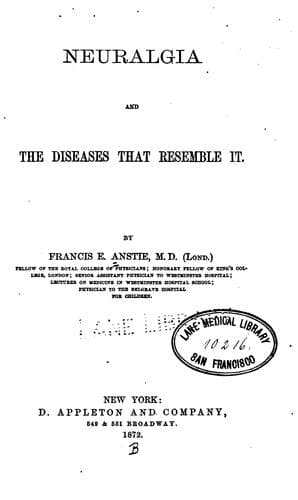
Neuralgia and the diseases that resemble itAnstie, Francis Edmund
Science
Neuralgia and the diseases that resemble it
Anstie, Francis Edmund
Neuralgia
J. E., aged forty-seven, a street and tavern singer, applied to me
(November 14, 1861), on account of severe pain in the right temporal
region, which had on the whole the character of neuralgia, though rather
more continuous than such pain usually is. He said that it commenced on
the 10th, without any particular provocation that he knew of, and that
it had hardly left him at all from that moment. It kept him awake at
night, and that circumstance seemed to account sufficiently for a very
worn and depressed look which he presented; he was otherwise a
robust-looking man, and at first denied having suffered from any
previous illness. The pain always came to a climax about one o'clock, A.
M., waking him out of his first sleep in agony, and allowing him little
rest for the remainder of the night; toward morning he would drop to
sleep for an hour or so. There was no particular tender point,
corresponding to any recognized neuralgic focus, yet the pain was
limited most strictly to a spot that might be covered with two
finger-points. There was no lachrymation nor conjunctival congestion,
and nothing to remark in any way about either eye. The patient was
ordered quinine in large doses, in the belief that the pain was
neuralgic. On the following day he reported himself a trifle better,
though still suffering greatly; and on the afternoon of that day there
was an almost complete intermission of the pain for several hours; but
it returned severely at the usual nocturnal period. On the 16th, at 10
A. M., he came to my house looking exceedingly ill, but the only
additional symptom that I could detect was a small droop of the right
eyelid. He was subcutaneously injected with one-fourth of a grain of
morphia and sent home, where he immediately fell into a heavy sleep that
lasted till bedtime. He awoke, undressed himself without feeling much
pain, and got to bed; after an hour or so of dozing he was awakened by
the pain, which was exceedingly severe. On the 17th he called on me in
the morning, and I at once perceived that the ptosis of the right eyelid
was much greater, and the right pupil was much dilated and insensitive,
and the external rectus was paralyzed; the man also wore a look of
stupidity, and answered questions with an apparent mental effort. I now
cross-questioned him more closely; and also explored the tibiæ and other
superficial bones: on the sternum a distinct though not very advanced
node was found. Upon this he was induced to confess that he had suffered
from chancre three years and a half previously, and subsequently had
"blotches" on the skin, which had quickly disappeared under treatment,
of which all that could be learned was, that it was fluid medicine and
did not make his mouth sore. He was immediately ordered to take two
grains of calomel in pill, with a little opium, every four hours. He had
only taken one dose when I was sent for to him, and found him in an
epileptiform convulsion, in which the left side of the body was almost
Public-domain text, read in full here on John Shaqi.
Reviews
Reviews
No reviews yet
Be the first to share your thoughts on this work.
Elsewhere in the archive
Join the Discussion
Join the discussion
Sign in to leave a comment or review.
Sign InorCreate an account