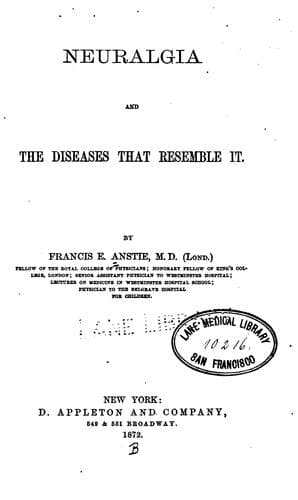
Neuralgia and the diseases that resemble itAnstie, Francis Edmund
Science
Neuralgia and the diseases that resemble it
Anstie, Francis Edmund
Neuralgia
The true neuralgias in which syphilis only plays the part of secondary
factor, and which have been referred to in Part I. of this work, may
depend for their exciting cause on local syphilitic processes, affecting
either the peripheral distribution, the main trunk or the central origin
of a sensory nerve; but I have pointed out the fact that, whatever the
reason may be, syphilis does but rarely attack the central portions of
individual sensory nerves, in comparison, with the frequency with which
it attacks individual motor (cranial) nerves. But without any neuralgic
predisposition at all, and without any limitation of the syphilitic
process to a particular sensory nerve, the latter may become neuralgic
in consequence of being involved in extensive intracranial or
intra-spinal syphilitic mischief. The trigeminus is liable to suffer in
this way from spreading syphilitic processes about the base of the
brain; and my own impression is, that the cause of the neuralgic pain in
some such cases is the extension of the mischief to the vertebral artery
of the affected side, leading to interfering with the nutrition of the
trigeminal nucleus in the medulla. A very interesting case is reported
by Dr. Hughlings Jackson (who has done so much to acquaint us with
syphilitic affections of cerebral arteries) in vol. iv. of the "London
Hospital Reports," pp. 318-321. The patient was a woman, aged
twenty-seven, and the initial symptoms of the malady which destroyed her
life were violent trigeminal neuralgic pains on the right side:
subsequently she had complete paralysis of the fifth, and of the sixth,
seventh, and eighth nerves of the right side. After death the right
vertebral artery was found engaged in the mass of syphilitic deposit; it
must be added, however, that the (superficial) origin of the fifth nerve
was itself softened, opposite the pons. Another mode in which syphilitic
disease very probably causes neuralgia of the fifth, in a certain number
of cases, is by injuring the Gasserian ganglion, upon the integrity of
which (according to Waller's general law concerning the ganglia of
posterior nerve-roots) the nutrition of the sensory root of the
trigeminus materially depends. I have seen an example (as I cannot but
suppose) of this sequence of morbid events; the evidence appears
sufficiently complete, although I was unable to obtain a _post mortem_
examination:
Public-domain text, read in full here on John Shaqi.
Reviews
Reviews
No reviews yet
Be the first to share your thoughts on this work.
Elsewhere in the archive
Join the Discussion
Join the discussion
Sign in to leave a comment or review.
Sign InorCreate an account