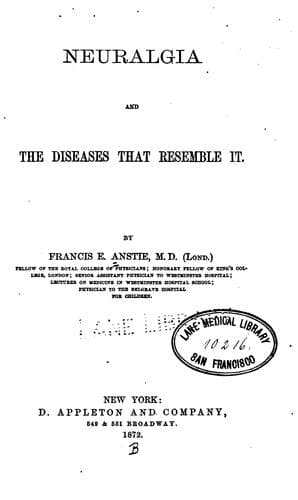
Neuralgia and the diseases that resemble itAnstie, Francis Edmund
Science
Neuralgia and the diseases that resemble it
Anstie, Francis Edmund
Neuralgia
L. P., aged thirty-one, single, a printer by trade, applied to me,
January, 1863, suffering from what I at first decidedly thought was
cervico-brachial neuralgia, the pain having followed exposure to cold
and wet, situated in the lower part of the neck, the shoulder, elbow and
inner side of the right arm, and existing nowhere else. The character of
the pain was described as at least remittent, if not distinctly
intermittent. The pulse was not more than 78; the tongue was thickly
coated with white fur, but the man did not complain of thirst, and there
were no evident signs of fever. As the pains had only existed for about
a fortnight, it appeared an excellent case for cure by the hypodermic
injection of morphia; and, accordingly this was used in quarter-grain
doses twice a day. After about ten days an attempt was made to do
without the morphia, but the pains returned, worse than before, and
meantime the tongue had remained uniformly coated, and was now very
yellow; the appetite was bad, and there was some increase in frequency
of pulse. It now struck me, for the first time, that the man presented,
in a slight degree, the sallow and red tint and oily features of a
rheumatic patient; it was now found that sweat and urine were distinctly
acid. Acting on this idea, I administered five grains of iodide of
potassium, and thirty grains of bicarbonate of potassium, four times
every twenty-four hours, after giving a moderate saline aperient. The
result was manifest improvement within twenty-four hours, and almost
complete relief of the pain within three or four days (the urine never
becoming distinctly alkaline, however.) As the attack subsided, the oily
appearance of the skin disappeared, and the rheumatic tint was replaced
by mere ordinary pallor, which the patient lost after taking a short
course of steel.
At the time this case occurred to me, I was not aware of the importance,
in doubtful instances, of looking to the temperature; but subsequent
experience has convinced me that in every truly rheumatic case, however
limited in extent, there is a real, though it may be a small, rise of
temperature. The thermometer will be found to mark from 99-1/4° to 100°
Fahr., and this, joined with the appearances above mentioned, and a
strong acidity of urine, will be sufficient to distinguish the complaint
as rheumatic; and the striking effect of such remedies as iodide with
bicarbonate of potash, followed up with sesquichloride of iron, in full
doses, helps still further to distinguish the cases from true
neuralgias. Since the introduction of the full doses of the
iron-tincture in the treatment of acute rheumatism, I have had the
opportunity of treating two of these cases of subacute rheumatism in the
same manner, viz., with the iron from the first, and the results have
been most satisfactory in every way. These cases were independent of a
much larger number, treated in the same way, in which the symptoms of
rheumatism were more generalized and more severe.
Public-domain text, read in full here on John Shaqi.
Reviews
Reviews
No reviews yet
Be the first to share your thoughts on this work.
Elsewhere in the archive
Join the Discussion
Join the discussion
Sign in to leave a comment or review.
Sign InorCreate an account