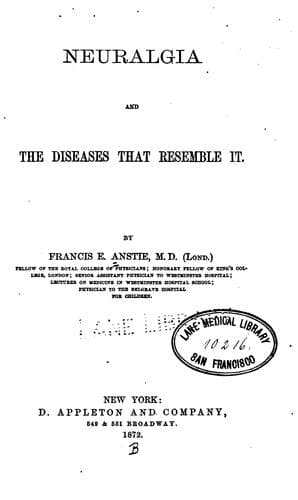
Neuralgia and the diseases that resemble itAnstie, Francis Edmund
Science
Neuralgia and the diseases that resemble it
Anstie, Francis Edmund
Neuralgia
The secondary affections which may arise as complications of neuralgia
form a deeply interesting chapter in nervous pathology, and one which
has only been explored in quite recent years. The excellent treatises of
Valleix and Romberg, written only thirty years ago, make but most
cursory and superficial mention of these complications, and do not
attempt to group them in a scientific manner. The reflex convulsive
movement of the facial muscles in severe tic-douloureux had of course
been long observed; and Valleix added the correct observation that
gastric disturbance was often secondarily provoked in facial neuralgia,
thus improving greatly on the old view, which supposed that, where
trigeminal neuralgia and stomach disorder coexisted, the latter must
have been the antecedent and the cause of the former. Still, he did not
explain the pathological connection. And as regards certain other most
interesting results of neuralgia, which he could not avoid meeting with
from time to time, _e. g._, lachrymation, flux from the nostril,
salivation, altered nutrition of the hair, he only speaks of these as
occasional phenomena, and in no way classifies them, or explains their
relation to the neuralgia itself.
There did exist, however, one too little known work of some years
earlier date, which, though not dealing specifically with neuralgia, and
though based upon the necessarily very imperfect knowledge of the
functions of the nervous system prevalent in its day, had nevertheless
done much to lay the foundation of a comprehensive view of the
complications of neuralgia; we refer to the work of the brothers
Griffin, on "Functional Affections of the Spinal Cord and Ganglionic
System," published in 1834. In this most interesting treatise, the
record of acute and extensive observations made in a quiet and
unpretending way by two Irish practitioners, numerous examples are cited
in which neuralgic affections were seen to be inseparably united with
secondary affections of the most various organs, with which the
neuralgic nerves could have no connection except through the centres, by
reflex action. The authors, while firmly grasping the fact of the common
connection of the nerve-pain and the other phenomena (convulsions,
paralysis, altered special sensation, changes in secretion, changes even
in the nutrition of particular tissues) with the central nerve system,
were doubtless in error in thinking that they could detect the precise
seat of the original malady, by discovering certain points of tenderness
over the spinal column. But their facts were observed with the greatest
care, and can now be interpreted more intelligently than was possible at
the time. Here, for example, is a case which forestalls one of the most
interesting pieces of information which more recent research has made
generally known:
Public-domain text, read in full here on John Shaqi.
Reviews
Reviews
No reviews yet
Be the first to share your thoughts on this work.
Elsewhere in the archive
Join the Discussion
Join the discussion
Sign in to leave a comment or review.
Sign InorCreate an account