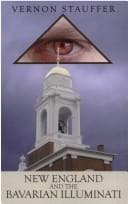
New England and the Bavarian IlluminatiStauffer, Vernon
History
New England and the Bavarian Illuminati
Stauffer, Vernon
Illuminati; New England -- Church history; Thesis (Ph. D.)
To the first grade of the third class, that of Priest,[385] were
admitted only such members as, in the grade Minerval, had given proof
of their zeal and advancement in the particular sciences which they
had chosen.[386] The initiatory ceremonies of the grade emphasized the
wholly unsatisfactory character of existing political and religious
systems and sounded the candidate’s readiness to serve the order in
its efforts to lead the race away from the vain inventions of civil
constitutions and religious dogmas from which it suffered.[387]
Relieved entirely of administrative responsibilities, the members of
this grade devoted themselves exclusively to the instruction of their
subordinates in the following branches of science: physics, medicine,
mathematics, natural history, political science, the arts and crafts,
and the occult sciences. In brief, the final supervision of the
teaching function of the order was in their hands, subject only to the
ultimate authority of their supreme heads.[388]
Knigge’s statutes provided that only a very small number of members
were to be admitted to the grade of Prince.[389] From this group
the highest functionaries of the order were to be drawn: National
Inspectors, Provincials,[390] Prefects, and Deans of the Priests. Over
them, in turn, at the apex of the system and as sovereign heads of the
order, ruled the Areopagites.[391]
So much for the external structure of the system which Knigge reshaped.
With respect to the aims and principles of the order the modifications
introduced by him were considerable, although scarcely as comprehensive
as in the former case.[392] In certain instances the ideas of Weishaupt
were retained and developed;[393] in others significant alterations
were made or new ideas introduced. Of the new ideas the two following
were unquestionably of greatest weight:[394] the notion of restricting
the field of recruiting solely to the young was abandoned, and this
phase of the propaganda was widened so as to include men of experience
whose wisdom and influence might be counted upon to assist in attaining
the objects of the order;[395] the policy was adopted that henceforth
the order should not occupy itself with campaigns against particular
political and religious systems, but that its energies should be
exerted against superstition, despotism, and tyranny.[396] In other
words, the battle for tolerance and enlightenment should be waged
along universal and not local lines. Accordingly, the esoteric teaching
of the order, under Knigge’s revision, was reserved to the higher
grades.
Public-domain text, read in full here on John Shaqi.
Reviews
Reviews
No reviews yet
Be the first to share your thoughts on this work.
Elsewhere in the archive
Join the Discussion
Join the discussion
Sign in to leave a comment or review.
Sign InorCreate an account