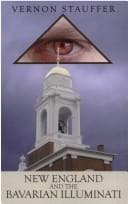
New England and the Bavarian IlluminatiStauffer, Vernon
History
New England and the Bavarian Illuminati
Stauffer, Vernon
Illuminati; New England -- Church history; Thesis (Ph. D.)
[368] Weishaupt’s original plan had been to leave the matter
of financial support to the discretion of the members. _Einige
Originalschriften des Illuminaten Ordens_, p. 16. Time, however, proved
the imprudence of this arrangement, and hence fixed dues, very modest
in their character, were imposed. Forestier, pp. 130 _et seq._
[369] _Ibid._, pp. 132 _et seq._
[370] Engel gives the date of the admission of Knigge as July, 1780.
_Cf._ _Geschichte des Illuminaten-Ordens_, p. 114. Forestier is less
specific. _Les Illuminés de Bavière, &c._, p. 217.
[371] Baron Knigge (born near Hannover, October 16, 1752; died at
Bremen, May 6, 1796) was a man of considerable distinction in his
day. He had studied law at Göttingen, and later had been attached
to the courts of Hesse-Cassel and Weimar. Retiring subsequently to
private life, he made his home successively at Frankfort-on-the-Main,
Heidelberg, Hannover, and Bremen. He was an author of note, a writer
of romance, popular philosophy, and dramatic poetry. His best known
work, _Ueber den Umgang mit Menschen_ (Hannover, 1788), a volume
filled with a discussion of practical principles and maxims of life
and characterized by a narrow and egoistical outlook, enjoyed a
considerable notoriety in its time. (Knigge’s complete works were
assembled and published in twelve volumes at Hannover, 1804–1806). He
had a decided bias for secret societies, and at the earliest moment
that his age permitted had joined a lodge of the Strict Observance,
one of the Masonic branches of the period. The Strict Observance
was particularly devoted to the reform of Masonry, with special
reference to the elimination of the occult sciences which at the
time were widely practised in the lodges, and the establishment of
cohesion and homogeneity in Masonry through the enforcement of strict
discipline, the regulation of functions, _etc._ (Later, the leaders
of the Strict Observance found themselves compelled to yield to the
popular clamor for the occult sciences which were all but universal in
European Freemasonry, and adopted them. Their presence and practice
had been influential in attracting Knigge to the Masonic system. _Cf._
Forestier, _op. cit._, p. 207.) Knigge’s Masonic career proved to be
of such a nature as to leave him restless and unsatisfied. Because he
was not permitted to enjoy the advancement in the order of the Strict
Observance that he coveted, he temporarily lost his interest in Masonry
only to have it revived a little later by being chosen to assist in the
establishment of a new Masonic lodge at Hanau. Meantime his interest in
the subjects of theosophy, magic, and particularly alchemy, grew apace.
On this account he was led to make an effort to affiliate himself with
the Rosicrucians, a branch of Freemasonry notorious for the absurdity
of its pretensions and its shameless pandering to the popular desire
for occultism. Knigge’s advance did not happen to be received with
Public-domain text, read in full here on John Shaqi.
Reviews
Reviews
No reviews yet
Be the first to share your thoughts on this work.
Elsewhere in the archive
Join the Discussion
Join the discussion
Sign in to leave a comment or review.
Sign InorCreate an account