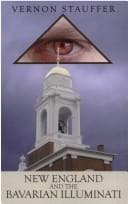
New England and the Bavarian IlluminatiStauffer, Vernon
History
New England and the Bavarian Illuminati
Stauffer, Vernon
Illuminati; New England -- Church history; Thesis (Ph. D.)
Such in its main outlines and in its “principal links” of evidence is
the _Proofs of a Conspiracy against all the Religions and Governments
of Europe_. Yet to obtain a just appraisal of the book it must not
be overlooked that its author wrote an additional one hundred and
fifty pages, not of “proofs” but of argument, partly to defend errors
of judgment he may have committed in his treatment of the subject,
but chiefly to persuade his fellow countrymen that the principles of
Illuminism were false and to urge them to turn a deaf ear to these
doctrines.
We turn now to consider another and much more elaborate exposition
of the Illuminati-French Revolution legend. Almost at the moment of
the appearance of Robison’s book, there appeared in French, at London
and Hamburg, a far more finished production, devoted to the same
thesis and bearing the title, _Mémoires pour servir à l’histoire du
Jacobinisme_.[545] Its author, the Abbé Barruel,[546] who had been
trained as a Jesuit, enjoying literary talents much superior to those
of Robison and relying upon documentary evidence more copious if not
more convincing, defined his purpose in the following manner:
We shall show that with which it is incumbent on all nations
and their chiefs to be acquainted: we shall demonstrate that,
even to the most horrid deeds perpetrated during the French
Revolution, everything was foreseen and resolved on, was combined
and premeditated: that they were the offspring of deep-thought
villainy, since they had been prepared and were produced by
men, who alone held the clue of those plots and conspiracies,
lurking in the secret meetings where they had been conceived,
and only watching the favorable moment of bursting forth. Though
the events of each day may not appear to have been combined,
there nevertheless existed a secret agent and a secret cause,
giving rise to each event, and turning each circumstance to
the long-sought-for end. Though circumstances may often have
afforded the pretense of the occasion, yet the grand cause of
the revolution, its leading features, its atrocious crimes, will
still remain one continued chain of deep-laid and premeditated
villainy.[547]
The amazing breadth of Barruel’s canvass, as well as the naiveté of
the artist, are immediately disclosed in his foreword respecting the
“triple conspiracy” which he proposes to lay bare.[548] To present
this “triple conspiracy” in his own words will do more than define the
abbé’s conception of his task: its transparent incoordination will make
it apparent that much of the work of examination that might otherwise
seem to be called for is futile.
Public-domain text, read in full here on John Shaqi.
Reviews
Reviews
No reviews yet
Be the first to share your thoughts on this work.
Elsewhere in the archive
Join the Discussion
Join the discussion
Sign in to leave a comment or review.
Sign InorCreate an account