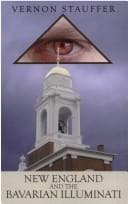
New England and the Bavarian IlluminatiStauffer, Vernon
History
New England and the Bavarian Illuminati
Stauffer, Vernon
Illuminati; New England -- Church history; Thesis (Ph. D.)
The public sanction which Morse gave to the charge that the Illuminati
were responsible for the afflictions of both the Old World and the
New was a new note on this side of the Atlantic. Sounded in New
England at a time when Europe was in convulsion and when the shift
from traditional social, political, and religious positions in America
was extremely rapid in its movement, this new alarm could not fail
to arrest attention. We have seen that the air of New England was
already surcharged with notions of implacable hostility to the forces
in control of church and state,[640] and with gloomy forebodings born
of surmises of intrigue and conspiracy.[641] The hour was electric.
The hard-pressed forces of religious and political conservatism were
bound to receive the new Shibboleth with unquestioning and eager
joy. Henceforth their arsenal would be enlarged to include a new
weapon. They would be able to point to the villainies, impieties, and
blood-lettings in Europe, to the flauntings, contumelies, and crafty
counter-manœuverings which the clergy and the heads of government had
to suffer in America, and assert that back of all these and binding
all together into a single vicious whole was a conspiracy whose object
was nothing less than the complete overthrow of civil government and
orthodox Christianity. To be able to brand political and religious
radicalism with a word as detestable as this new word “Illuminism”
which had just come across the Atlantic, should indeed prove sufficient
to damn that cause.
The immediate effect produced by the sermon fell considerably short of
a sensation. For one thing the subject of the Illuminati was new and
unfamiliar in New England. Much more significant, however, is the fact
that at the time the sermon came to public attention, the long-expected
X. Y. Z. despatches were passing through the newspaper presses of the
country and inflaming the national spirit to an incredible degree.
In view of the fact that innumerable public assemblies were being
held and innumerable patriotic addresses drawn up and presented to
the President, all inspired by the prospect of and the demand for
an immediate rupture with France, it is not surprising that the
minister of Charlestown did not succeed in creating a more instant and
widespread alarm than he did.
However, he had no reason to be disappointed. The spark which he had
communicated to the tinder might seem to smoulder for a season,[642]
but in due course it was bound to burst into flame. That Morse was
himself well content with the degree of interest which the public
manifested in his disclosure of the “conspiracy” is evident from
the following letter that he addressed to Oliver Wolcott, within a
fortnight of the date of the national fast:
Charlestown, May 21, 1798.
_Dear Sir_,
Public-domain text, read in full here on John Shaqi.
Reviews
Reviews
No reviews yet
Be the first to share your thoughts on this work.
Elsewhere in the archive
Join the Discussion
Join the discussion
Sign in to leave a comment or review.
Sign InorCreate an account