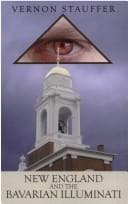
New England and the Bavarian IlluminatiStauffer, Vernon
History
New England and the Bavarian Illuminati
Stauffer, Vernon
Illuminati; New England -- Church history; Thesis (Ph. D.)
Thus it will appear that Tappan became an echo of Morse. As for Timothy
Dwight, the contribution he made to the awakening of public interest
in the subject of Illuminism requires somewhat stronger statement. In
the person of the president of Yale this new idea of a definite and
deep-laid conspiracy against religion and civil government encountered
a highly sensitized mind. Upon the subjects of infidelity and the
general irreligious tendencies of the times, Dwight had been speaking
frequently and for years from his lecture-desk in the classroom and
from his pulpit in the church. It is safe to say that among all the
men of New England no man’s spirit was more persistently haunted by
the fear that the forces of irreligion were in league to work general
ruin to the institutions of society than his. When, therefore, on
the occasion of the Fourth of July, 1798, the people of New Haven
assembled to do honor to the day in listening to a sermon by the
honored president of their college, it was to be expected that if the
latter had any new information to impart or any new pronouncement to
make respecting malign efforts that were making to plunge the world
into irremediable scepticism and anarchy, he would seize the occasion
that the day offered to arouse in his hearers a sense of the new perils
which threatened. And President Dwight _had_ new information and a new
pronouncement to offer.
The subject which he chose to discuss on that Independence Day, and
the text upon the elucidation of which he relied for the illumination
of the subject, were in themselves calculated to excite concern. These
were respectively, THE DUTY OF AMERICANS AT THE PRESENT CRISIS, and
“Behold I come as a thief: Blessed is he that watcheth, and keepeth
his garments, lest he walk naked, and they see his shame.” (Revelation
xvi: 16.)[659] Having first explained the setting of the text,
President Dwight then proceeded to define the thesis of his sermon in
the following manner: “From this explanation it is manifest that the
prediction consists of two great and distinct parts: _the preparation
for the overthrow of the Antichristian empire; and the embarkation of
men in a professed and unusual opposition to God, and to his kingdom,
accomplished by means of false doctrines, and impious teachers_.”[660]
The first of these predictions, it was asserted, had been fulfilled
in the repressive and secularizing measures that during the century
had operated to weaken greatly the Catholic hierarchy and its chief
political supports among the states of Europe.[661] The second was
experiencing a fulfilment not less remarkable in the open and
professed war against God and his kingdom, in which Voltaire, Frederick
II, the Encyclopedists, and the Societies of the Illuminati had
confederated.[662]
Public-domain text, read in full here on John Shaqi.
Reviews
Reviews
No reviews yet
Be the first to share your thoughts on this work.
Elsewhere in the archive
Join the Discussion
Join the discussion
Sign in to leave a comment or review.
Sign InorCreate an account