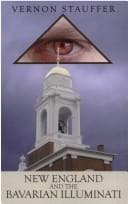
New England and the Bavarian IlluminatiStauffer, Vernon
History
New England and the Bavarian Illuminati
Stauffer, Vernon
Illuminati; New England -- Church history; Thesis (Ph. D.)
The _Aurora_ steered a similar course. Drawing upon the _Bee_, the
text of the alleged Ebeling-Morse letter was printed[845] and the
accompanying comment made that this effectually disposed of the
Illuminati.[846] It was now fully apparent that Morse had seized upon
the idea of a conspiracy against religion and the state in order to
further selfish and partisan ends. He and Dr. Dwight, who were at
the head of the clerical systems in Massachusetts and Connecticut
respectively, were exhausting all the means in their power to exalt
Federalism and to obtain a religious establishment which would deliver
the consciences and purses of the nation into the hands of their
party.[847] The rancor that these two men had recently stirred up
against the respectable fraternity of Freemasons was due solely to
their bigotry.[848]
Meantime a certain shrewd and none too scrupulous Democratic clergyman
in Massachusetts was deriving such satisfaction as he could out of
Morse’s discomfiture and bitter resentment. The letter that the _Bee_
and the _Aurora_ published as a letter from Ebeling to Morse was in
fact a letter from Ebeling to William Bentley,[849] inveterate hater of
Morse.[850]
Ebeling, it appears, had written the letters to Bentley and to Morse
at about the same time.[851] A little after the receipt of his letter,
Bentley had learned from Ebeling that Doctors Pearson, Tappan, and
Morse all were inquiring of Ebeling concerning Robison’s standing as
a historian, and that the Hamburg professor had addressed Morse at
length upon the subject.[852] Further, he received clear hints from
Ebeling as to the precise nature of the communications to Morse.[853]
Bentley, therefore, had substantial reasons for believing that he was
in full possession of the information that Ebeling had furnished Morse
regarding the subsidence of the Illuminati craze in Europe and the
unfavorable opinions of Robison that were entertained on the other side
of the Atlantic. It certainly was not to his credit, however, that he
should permit a letter which he himself had received from Ebeling to be
published as a communication from Ebeling to Morse.[854]
Under the circumstances, Morse was placed in a position of
embarrassment and humiliation from which he found it impossible wholly
to extricate himself.[855] What is more to the point, the cause which
in his misguided zeal he had been promoting was thus made to suffer an
irreparable blow. With his personal integrity under grave suspicion
and his main European ally held up to public ridicule and scorn,
even Morse’s obdurate spirit must have foreseen that the collapse of
the agitation which he had fostered could not long be deferred. Even
without this tumble into the slough of suspicion and contempt, time
must soon have brushed aside as groundless the alarm that Morse had
sounded. It is not difficult to imagine, however, that time might have
found ways less vindictive and scurvy to dispose of the excited clamor
of Morse.
Public-domain text, read in full here on John Shaqi.
Reviews
Reviews
No reviews yet
Be the first to share your thoughts on this work.
Elsewhere in the archive
Join the Discussion
Join the discussion
Sign in to leave a comment or review.
Sign InorCreate an account