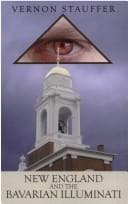
New England and the Bavarian IlluminatiStauffer, Vernon
History
New England and the Bavarian Illuminati
Stauffer, Vernon
Illuminati; New England -- Church history; Thesis (Ph. D.)
With the clergy—and in their state of mind we are interested
especially—this feeling was hardly less than an obsession. The special
conservators of the moral and religious health of the people, they
had long been concerned over the possible effects of radical French
political and religious notions; and when they seemed to see the
triumph of those notions in the excesses of the French Revolution,
their sense of alarm was intense. It was, of course, the exhibition
of violent hostility to organized Christianity in France which the
Revolutionists were making, over which their hands were flung high in
horror.
The clergy of New England, like the majority of their
fellow-countrymen, in the beginning had not adopted an attitude of
hostility toward the French upheaval. There was that in the earlier
struggles of the French people to tear the yoke of despotism from
their necks which appealed mightily to the sympathies of the clerical
heart. It was not without some travail of spirit that clergymen arrived
at the conclusion that their sympathy and enthusiasm for the French
Revolution had been misplaced.[196] Two factors contributed to this
result. In the first place, the changed complexion of the Revolution;
in the second place, the new party alignments at home which brought the
orthodox clergy, almost to a man, into the Federalist camp.
Which of these two factors was the more decisive in its power of
control over the clerical mind, it would be difficult to say.
As a matter of fact, the two influences were interrelated to an
extraordinary degree. Political alignments, as we have seen, were
interwoven closely with the question of foreign alliances. Conversely,
the status of foreign affairs was bound to react strongly upon the
judgments of clergymen with whom patriotic concerns were second in
importance only to the interests of religion. Be that as it may, the
years 1793 and 1794 saw the Federalist clergy in New England rapidly
veering round to the fixed position of vehement antagonism to French
principles. The following is a brief account of the course they pursued.
On the occasion of the annual fast in Massachusetts, April 11, 1793,
the Reverend David Tappan, professor of divinity in Harvard College,
preached a sermon that indicated the trend of a clerical mind.[197] In
language not unmarked by vagueness, he called upon his hearers to bear
witness to the present corrupted state of religion, due to the bold
advance and rapid diffusion of “sceptical, deistical, and other loose
and pernicious sentiments.” Waxing more confident, he continued: “May
I not add that a species of atheistical philosophy, which has of late
triumphantly reared its head in Europe, and which affects to be the
offspring and the nurse of sound reason, science, and liberty, seems
in danger of infecting some of the more sprightly and free-thinking
geniuses of America.”[198]
Public-domain text, read in full here on John Shaqi.
Reviews
Reviews
No reviews yet
Be the first to share your thoughts on this work.
Elsewhere in the archive
Join the Discussion
Join the discussion
Sign in to leave a comment or review.
Sign InorCreate an account