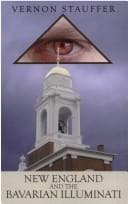
New England and the Bavarian IlluminatiStauffer, Vernon
History
New England and the Bavarian Illuminati
Stauffer, Vernon
Illuminati; New England -- Church history; Thesis (Ph. D.)
(This volume appears to have been published pseudonymously. Advertised
in Lancaster, Pa., Intelligencer and Advertiser, October, 1800); (16)
Boudinot, Elias, _The Age of Revelation, Or, The Age of Reason shewn to
be an Age of Infidelity_, Philadelphia, 1801.
[167] _Cf._ Morse, _The Federalist Party in Massachusetts_, Appendix
I, pp. 217 _et seq._, for a detailed and fairly satisfactory statement
of the character and extent of the discussion which Paine’s book
precipitated in New England.
[168] Channing, _Memoirs_, vol. i, pp. 60, 61. On the latter page
it is asserted that in order to counteract such fatal principles as
those expressed in the _Age of Reason_, the patrons and governors
of Harvard College had Watson’s _Apology for the Bible_ published
and furnished to the students at the expense of the corporation.
This was in 1796. Beecher’s _Autobiography, Correspondence, etc._,
vol. i, pp. 30, 35, 52, touches upon the situation at Yale. _Cf._
Dwight, _Theology: Explained and Defended_, vol. i, pp. xxv, xxvi. The
extensive prevalence of infidelity among Yale students is commented
upon and the statement made that a considerable proportion of the class
which President Dwight first taught (1795–96) “had assumed the names of
principal English and French Infidels; and were more familiarly known
by them than by their own.” (_Ibid._) _Cf._ Dorchester, _Christianity
in the United States_, p. 319.
[169] The impression lingered on after the stir caused by the
appearance of the _Age of Reason_. In 1803 Paine was in southern New
England. His presence was disturbing, as the following comment of
William Bentley will show: “Reports are circulated that Thomas Paine
intends to visit New England. The name is enough. Every person has
ideas of him. Some respect his genius and dread the man. Some reverence
his political, while they hate his religious, opinions. Some love the
man, but not his private manners. Indeed he has done nothing which has
not extremes in it. He never appears but we love and hate him. He is as
great a paradox as ever appeared in human nature.” (_Diary_, vol. iii.
p. 37. _Cf. ibid._, vol. ii. pp. 102, 107, 145.)
[170] Hazen, _Contemporary American Opinion of the French Revolution_,
pp. 141 _et seq._
[171] _Ibid._, p. 143.
[172] Dwight, _Travels_, vol. iv, p. 361.
[173] _Writings of Thomas Jefferson_, vol. v, pp. 154, 274;
_Massachusetts Historical Collections, Sixth Series_, vol. iv, _Belknap
Papers_, p. 503.
[174] The entire episode is treated with great fullness and equal
vividness by Hazen, _Contemporary American Opinion of the French
Revolution_, pp. 164–188.
[175] _Writings of Thomas Jefferson_, vol. vi, pp. 153 _et seq._
Public-domain text, read in full here on John Shaqi.
Reviews
Reviews
No reviews yet
Be the first to share your thoughts on this work.
Elsewhere in the archive
Join the Discussion
Join the discussion
Sign in to leave a comment or review.
Sign InorCreate an account