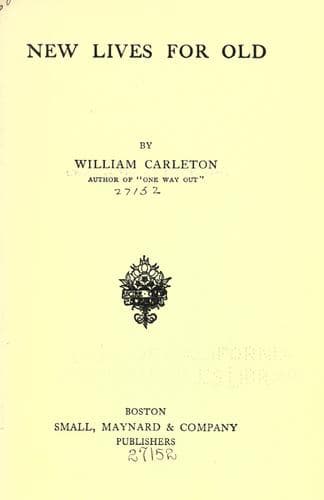
Agriculture, Cooperative -- Fiction; Country life -- Fiction; Farmers -- Fiction; New England -- Fiction; Villages -- Fiction
One other point came up for discussion in the course of the winter and
that was the question of specialization; of whether as a community
it would pay us better to center our efforts upon some one line such
as dairy products, meat products, vegetable products or what not, or
whether it wasn’t better as small farmers with no particular advantages
of soil or market for us to carry on diversified farms. On the whole
the latter was the opinion of the school experts and also carried the
strongest appeal to the majority of us. If every man kept at least one
cow, a hog or so, a few sheep and a few hens, he first of all was then
in a position to supply himself--and after all a man is his own best
market--and secondly it gave him a more regular income as his stock
didn’t develop for the market all at one time; and thirdly, he didn’t
put all his eggs in one basket. A man specializing for instance in
poultry is apt by disease to lose his whole flock and the same is true
of his herd or his hogs. A diversified farm makes a man independent
of market conditions. If poultry is low and eggs high he can keep his
pullets for eggs. If beef is low and butter high, he can keep his cows
for milk and vice versa. In other words, he isn’t forced to sell at
certain times regardless of what the market is.
One thing, however, was insisted upon, that so far as possible a man
should keep the best of each kind. This led to the subject of breeding,
and this led in turn to the question of whether to this end it wasn’t
possible for us as a group to invest in a common breeder--a blooded
bull, a blooded ram, which as individuals none of us could afford. And
this again led, as about everything we touched upon that winter had
led, to the question of closer coöperation. Two hundred years ago the
Indians and various other forces which to-day seem to us only romantic
led our ancestors to coöperate in a certain way; to-day economic
conditions are bringing about the same result. In February the one
thought that was uppermost in the minds of us all was coöperation.
CHAPTER XIII
GETTING TOGETHER
For two winters we had met together and amused ourselves together.
That was what counted--counted even more than the work we had done
together. Perhaps you wouldn’t think that this social intercourse and
the establishment of this common pioneer background was of any great
importance, but if you had been one of us you would surely have felt
its importance. It made us one big family as nothing else in the world
could have done. Church societies build up as many barriers as they
break down; so, too, do fraternal and political societies. But here we
went back to a meeting ground which kept us shoulder to shoulder with
one another and with our common past. Men and women can be entertained
together when nothing else is possible.
Public-domain text, read in full here on John Shaqi.
Reviews
Reviews
No reviews yet
Be the first to share your thoughts on this work.
Elsewhere in the archive
Join the Discussion
Join the discussion
Sign in to leave a comment or review.
Sign InorCreate an account