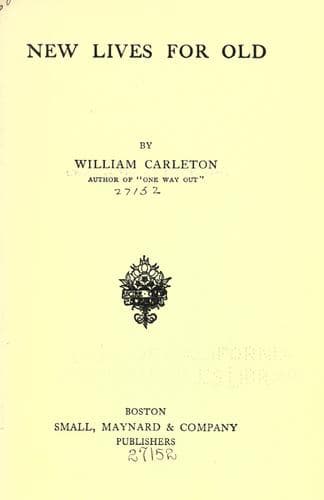
Agriculture, Cooperative -- Fiction; Country life -- Fiction; Farmers -- Fiction; New England -- Fiction; Villages -- Fiction
Now about our experiment in raising our own meat. That, too, has been
a fair success. The local butcher fought us for a little while but his
fight was hopeless. Understand, there was no attempt to boycott him or
anything of that sort, but we were most of us raising our own poultry
and pork and besides that we weren’t eating as much meat as we did.
Still there was some demand chiefly for beef. We made a proposition
to the man; that we turn in to him what meats we produced for the local
market and that he handle them on a basis of ten per cent. net profit.
He thought it over for a little while and then accepted. He has made a
good thing out of it and so have we.
I don’t want anyone to get the idea that our town is any Utopia. It
isn’t. It is nothing but a steady, prosperous farming community where
everybody is a hard worker. We aren’t doing half of what we might, but
our satisfaction comes in knowing we are doing more than we did. As
the years go by we hope to do more. There isn’t any reason I can see
why as a town we shouldn’t be in the position of any well-conducted
city business increasing our efficiency and with that our profits.
Real estate has almost doubled here, and this hasn’t been a fictitious
doubling. It is based on what land is worth to the investor who becomes
one of us and uses his land intelligently. No one can buy land in our
town, loaf on it and share our prosperity. We aren’t dividing any
profits except among those of us who earn them.
People have come to our town and tried to locate the secret of our
modest success in our land, in the coöperative idea, in our favorable
position to the market, in just our bull luck. Most of these men and
women haven’t sense enough to be worth bothering with. I haven’t
much patience with those who look to find the solution of all our
difficulties in some arbitrary system that doesn’t take the individual
into account. But now and then comes along a man who is in earnest.
Then I take him around and introduce him to Josh Chase. He sees a
long-legged, thin-faced fellow with skin as bronze as a skipper’s. Then
Josh takes the visitor over his ten acres of land with the pride of a
king. He shows him a new barn and all his carefully cared for farming
implements. He takes him into a modest story and a half white house and
introduces him to Mrs. Josh and a couple of rosy-cheeked children. With
half an eye the man can see that here is prosperity of the best kind.
“Well?” the man is apt to ask me.
“He isn’t afraid of the rain any more,” I say.
“Well?”
“That’s all. It means he isn’t afraid of work. He’s up at daybreak
every morning in the year and his work isn’t done till dark. But you
wouldn’t pick him out as a slave, would you? He doesn’t look like a
poor downtrodden savage, does he? He’s a man with a hoe all right but
is he making any bid for your sympathy?”
“That’s because your coöperative idea--”
Public-domain text, read in full here on John Shaqi.
Reviews
Reviews
No reviews yet
Be the first to share your thoughts on this work.
Elsewhere in the archive
Join the Discussion
Join the discussion
Sign in to leave a comment or review.
Sign InorCreate an account