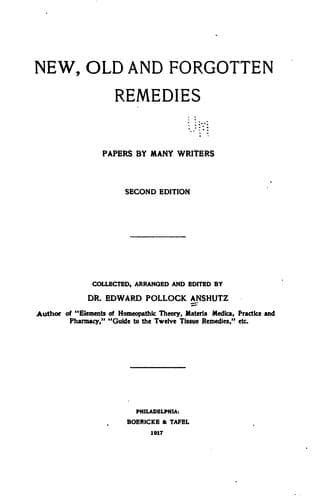
New, Old, and Forgotten Remedies: Papers by Many Writers
Science
New, Old, and Forgotten Remedies: Papers by Many Writers
Homeopathy -- Materia medica and therapeutics
No. 4. Since my article on neuralgia I had a quite severe case of
sciatica that had taxed the skill of one of my worthy competitors for
nearly two months without any good results; he was about to go to Hot
Springs for some relief. Meeting me on the street, wanted to know if I
thought any of my "little pills or drops would give any relief." I
assured him that I was quite positive that I could. He could hardly move
about, and suffered very much if he did; he came and got a prescription
and found relief to his great astonishment almost immediately; has had
it refilled twice and has worked every day; he takes the remedy morning
and night; there is no pain or soreness, nor has there been any after
first day, only if he sneezes or gets the leg cramped there seems to be
slight contraction of nerve, but the remedy has done most satisfactory
work in this case and gained a valuable family.
I hope these few cases may be of some benefit to the readers of the
_Recorder_: 1. Be careful to observe the rule that if remedy should
nauseate cease giving for twelve or twenty-four hours. 2. Always give on
sugar or in tablets. 3. Remove it immediately from room after
administering. 4. Cover joints to exclude air and keep them warm. 5.
Give any other indicated remedy.
HELODERMA HORRIDUS.
PREPARATION.--The virus, obtained by irritating the animal and allowing
it to bite on glass, is triturated in the usual way.
(Dr. T. L. Bradford furnishes us with the following
classification of this reptile):
The heloderma is classed as follows: Order: Saurii. Lacertilia. Lizards.
Sub order: 5. Fissilinguia. Family: Lacratidæ. Heloderma horridum of
Mexico; the crust lizard; the Mexican Caltetopen. Called heloderma from
its skin being studded with nail or tubercle-like heads. The Gila
monster is a native of Arizona, New Mexico and Texas. It is smaller than
the Mexican variety, and is called, by Cope, Heloderma Suspectum. It is
the only lizard whose character is not above reproach, hence the name.
Zoology says: An esquamate-tongued lizard with clavicles not dilated
proximally, a postorbital arch, no postfront-osquamosal arch, the pre
and post frontals in contact, separating the frontal from the orbit, and
furrowed teeth receiving the different ducts of highly developed
salivary glands.
(There has been considerable difference of opinion as to
whether the Heloderma is poisonous or not; but the
following abstract from a paper on the subject read
before the College of Physicians, Philadelphia, 1883, by
S. Wier Mitchell, together with the provings made later,
ought to very effectually settle all dispute on this
point; the conclusions are the result of experiments on
animals):
The poison of heloderma causes no local injury. It arrests the heart in
diastole, the organ afterwards contracts slowly--possibly in rapid rigor
mortis.
Public-domain text, read in full here on John Shaqi.
Reviews
Reviews
No reviews yet
Be the first to share your thoughts on this work.
Elsewhere in the archive
Join the Discussion
Join the discussion
Sign in to leave a comment or review.
Sign InorCreate an account