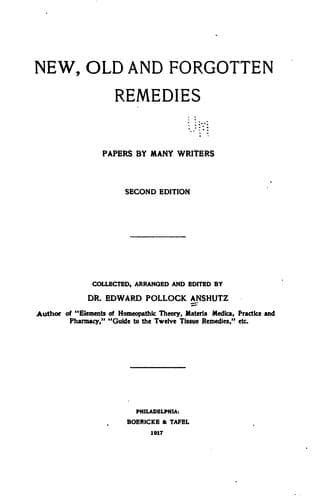
New, Old, and Forgotten Remedies: Papers by Many Writers
Science
New, Old, and Forgotten Remedies: Papers by Many Writers
Homeopathy -- Materia medica and therapeutics
It is a perennial plant, with herbaceous or slightly shrubby stems, the
foliage remaining green during winter when grass is scarce, and so
attracting animals that would otherwise probably instinctively shun it.
The plants do not appear to be equally poisonous at all seasons or in
all localities, and it has been doubted whether the active properties
they possess are due to a normal constituent of the plant. No medical
use has ever been made of these plants, although their poisonous
character has often led to the suggestion that they might be found
valuable. No physiological study has been made of the action of the
poison, and no complete chemical analysis has as yet appeared.
The stockmen speak of it as causing intoxication in the animals which
eat it, and a prominent symptom is the "loco" condition, in which the
power of co-ordination is lost or greatly limited. They cannot readily
readjust for changes in gait, etc. A horse travels on level ground, but
finds great difficulty in changing to pass over an elevation or
depression, or, when going up hill, he has great difficulty in starting
down hill; it is difficult, when he is still, to impress him that he
must go, and as difficult to stop him when desired. The same rule
applies to eating and other necessaries. Such a horse is said to be
"locoed." Professor Hawkes procured specimens from which Boericke &
Tafel made a tincture. To further test the merits of the remedy, the
students of the class at Hahnemann Medical College of Chicago kindly
participated in a proving.
Professor Hawkes received some reports from his group, but has mislaid
his papers, and he is unable to give in detail the symptoms produced. He
stated, however, that the principal action corroborated that given
above.
During 1886-'87 term I made another attempt, and a few reports were
received. The remedy was given by number, that the prover should not
know what he took, nor the strength of it. Some were given the [Greek:
theta], others 1x^d, 2x^d, 3x^d, 12x powders, 30x powders, and some
higher.
A few reported "no effect" from the [Greek: theta]. The following
includes the report from five persons:
1. (Mr. S. P. F., 10 drops of [Greek: theta].) 2. (Mrs. W., 10 drops of
3x^d repeated.) 3. (Mr. G. H. A., 15 drops of 3x^d.) 4. (Mrs. P.,
powders of 12x repeated.) 5. (Mrs. L., powders of 30x.) 6. (Mrs. L.,
powders of 12x.)
SYMPTOMATOLOGY.
_Mind._--Great mental depression,^1,^3. Cannot think or concentrate his
thoughts,^1,^3. Very forgetful of familiar words and names,^3. No
life,^1. Disinclination to talk or study,^3. Wants to be alone,^3. Is
better satisfied to sit down and do nothing,^3. Feels perfectly
despondent,^3. A feeling as if I would lose consciousness,^3. All
symptoms worse when thinking of them,^1,^3.
_Sensorium._--Strange sensation about the head,^4. A feeling as if I
would lose consciousness, or as if I would fall when standing,^5. Sense
of fulness of the head, and of instability, when standing or sitting,^6.
Public-domain text, read in full here on John Shaqi.
Reviews
Reviews
No reviews yet
Be the first to share your thoughts on this work.
Elsewhere in the archive
Join the Discussion
Join the discussion
Sign in to leave a comment or review.
Sign InorCreate an account