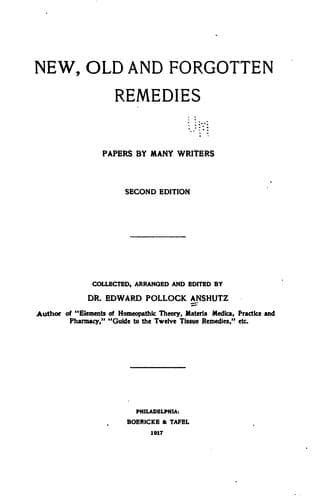
New, Old, and Forgotten Remedies: Papers by Many Writers
Science
New, Old, and Forgotten Remedies: Papers by Many Writers
Homeopathy -- Materia medica and therapeutics
A lady physician, aged thirty, married, no children, never has been sick
except with childhood diseases. Two years ago had considerable mental
trouble and rode a bicycle a good deal. Since that time, two years ago,
five times each minute, or about that, her heart would give one hard
unpleasant throb, then omit one beat, this in the day time, but much
worse at night, preventing sleep. Being in somewhat of a hurry, I did
not examine the heart, thinking there would be a plenty of time later,
but gave her _Phaseolus_, the 10th I think. Thirty-six hours later the
heart would beat one hundred consecutive times without the slightest
variation, and it continued to improve, although after taking the
medicine thirty-six hours she was obliged to desist on account of a
severe headache. She is never subject to headaches, but it was so bad
she dared not take any more of the medicine. It was as if something was
pressing hard against each temple, much worse soon after taking each
dose of the medicine. This headache led me to fear that the death I
mentioned might have been hastened by the medicine.
A medical conundrum. A lady, aged about thirty, decided she would
investigate the next world to see if she could enjoy it better than
this, and called in the aid of morphine to help her along. Not being in
the habit of taking morphine, to disguise the bitter of it, placed a
tablet of morphine in the middle of a baked bean and swallowed it whole.
She took her little dose in the evening, having eaten nothing since
noon, and went to sleep. At seven in the morning she awoke and was
surprised to find herself in this world. When asked if she would get up,
replied, no, she would sleep a little longer. At eleven A.M. she awoke
and tried to get up, but could not walk, so crawled to the door and
opened it to let in fresh air. A servant found her there, and at her
request handed her the camphor bottle, and she took a little. Dr. Rowe
was called and said she vomited a little mucus, some dark specks that
looked like blood, and a small piece of lettuce she ate the noon before.
She had taken twelve and one-half grains of morphine. Did the lettuce
antidote it? Did the bean destroy its power? Why did it not kill her?
POTHOS.
NAT. ORD., Araceæ.
COMMON NAME, Skunk Cabbage.
PREPARATION.--The fresh root gathered in spring is macerated in twice
its weight of alcohol.
(Contributed by Dr. S. A. Jones to the _Homoeopathic
Recorder_, 1889.)
This perennial, odorous member of the natural order _Araceæ_ is one of
our most common meadow and bog plants. From its very realistic,
skunk-like odor when cut or bruised, and its resemblance in shape of
leaf and mode of growth to the cabbage, it has been commonly well known
as the skunk cabbage.
Public-domain text, read in full here on John Shaqi.
Reviews
Reviews
No reviews yet
Be the first to share your thoughts on this work.
Elsewhere in the archive
Join the Discussion
Join the discussion
Sign in to leave a comment or review.
Sign InorCreate an account