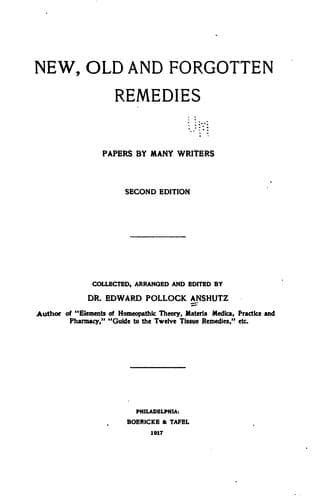
New, Old, and Forgotten Remedies: Papers by Many Writers
Science
New, Old, and Forgotten Remedies: Papers by Many Writers
Homeopathy -- Materia medica and therapeutics
A young woman, about eighteen years of age, was harassed by severe
convulsive and hysteric paroxysms, almost incessantly, insomuch that her
friends estimated the number at seven hundred in the course of a few
weeks; her abdomen was remarkably tumefied and tense, and there was a
singular bloatedness of the whole surface of her body, and the slightest
touch would occasion intolerable pain. At length her extremities became
rigid and immovable (_sic_), and her jaw was so completely locked that
she was unable to articulate, and liquids could only be introduced
through the vacuity of a lost tooth. She had been treated with a variety
of anti-spasmodic and other medicines, by an experienced physician,
without relief. Having prepared a strong infusion of the dried root of
skunk cabbage, I directed half a teacupful to be given every few hours,
without any other medicine; the favorable effects of which were soon
observable, and by persisting in the use of it about ten days the
muscular contractions were removed, the jaw was relaxed, and her faculty
of speech and swallowing, with the use of all her limbs, were completely
effected.
Another young woman had been exercised with the most distressing
paroxysms of hysteria for several days, without obtaining relief by the
medicines prescribed, when the skunk cabbage infusion was so
successfully directed that her fits were immediately arrested, and in a
few days a cure was completely effected.
The brother of this patient was seized with violent convulsions of the
whole body, in consequence of a cut on his foot; the skunk cabbage was
administered, and he was speedily restored to perfect health.
A woman was affected with violent spasmodic pains, twenty-four hours
after parturition; six doses of skunk cabbage entirely removed her
complaints.--_American Modern Practice_, p. 530.
_Barton._--The smell from spathe and flowers is pungent and very subtle.
Experience leads me to believe they possess a great share of acridity;
_having been seized with a very violent inflammation of my eyes_ (for
the first time in my life), which deprived me of the use of them for a
month, by making the original drawings of these plates. The pungency of
the plant was probably concentrated by the closeness of the room, in
which many specimens were at the time shut up.--_Veg. Mat. Med._, 1,
128. [The italics are not in the original text.]
The seeds are said to afford more relief in asthmatic cases than the
root; and this I believe very probable, for they are remarkably active,
pungent, and, as has before been mentioned, exhale the odor of
Asafoetida.--_Op. cit._, p. 131.
Public-domain text, read in full here on John Shaqi.
Reviews
Reviews
No reviews yet
Be the first to share your thoughts on this work.
Elsewhere in the archive
Join the Discussion
Join the discussion
Sign in to leave a comment or review.
Sign InorCreate an account