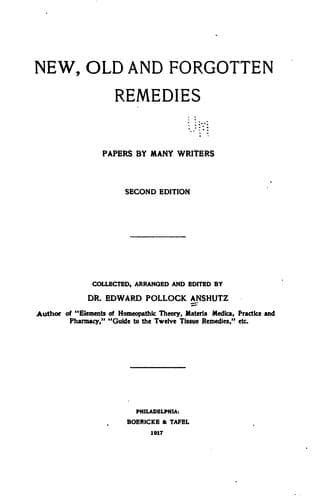
New, Old, and Forgotten Remedies: Papers by Many Writers
Science
New, Old, and Forgotten Remedies: Papers by Many Writers
Homeopathy -- Materia medica and therapeutics
Readers who are interested in the remedies of nature rather than those
produced in the laboratory and sold under trademarks will remember that
it was Dr. D. L. Phares, of Mississippi, who, over half a century ago,
pointed out the wonderful virtues of _Passiflora incarnata_, so much
used to-day. What Dr. Phares said of the remedy laid dormant until Hale,
in his ever perennial _New Remedies_, rescued it from the dusty pages of
old medical journals, in which so much of value is buried awaiting
resurrection. Among such buried remedies is _Saururus cernuus_ or, as it
is more commonly known, "lizard's tail." Dr. Phares, who seems to have
been an unusually keen observer, used _Saururus cer._ in his practice,
as he did _Passiflora_, for many years before he communicated his
observations to the medical journals, and the _Saururus_ seems to be
quite as important and useful a remedy in its sphere as is _Passiflora_,
and one quite as worthy of a thorough proving. In absence of proving it
may be said that Dr. Phares used it for years with marked success in all
irritation and inflammation of the kidneys, bladder, prostate and
urinary passages. He considered it peculiarly adapted to all such cases
if they were attended by strangury, or painful and difficult urination.
Dr. Phares used the remedy both externally and internally and he found
that the stomach was very tolerant of the rather heroic doses he
prescribed.
The plant is an indigenous perennial found in swampy localities, in some
parts of the United States, and has been, and is still, used in domestic
practice for those conditions for which Dr. Phares commends it.
SCOLOPENDRA MORSITANS.
PREPARATION.--The insect is triturated with sugar of milk in the usual
way.
(In the case of a man bitten in the arm by a centipede,
reported in _Nashville Journal of Medicine_, 1870, among
the striking symptoms was no perspiration in the arm for
three months. Dr. Sherman, of California (_Med.
Advance_), reports the following symptoms as prominent in
a woman bitten by a centipede:)
_Head._--Vertigo, with blindness, worse in the morning.
_Stomach._--Nausea and vomiting; unable to retain either food or liquid.
_Back._--Terrible pains in back and loins, spasmodic and irregular, at
times extending down the limbs. Pains returned every few days for three
weeks, commencing in the head and going out at the toes. "Resembled
labor pains as nearly as anything I ever saw."
SCUTELLARIA LATERIFOLIA.
NAT. ORD., Labiatæ.
COMMON NAME, Mad-dog skullcap.
PREPARATION.--The whole fresh plant is macerated in twice its weight of
alcohol.
(The following proving of _Scutellaria lat._, from
_University Bulletin_, 1897, was made, under the auspices
of Dr. Geo. Royal, by nine provers:)
Public-domain text, read in full here on John Shaqi.
Reviews
Reviews
No reviews yet
Be the first to share your thoughts on this work.
Elsewhere in the archive
Join the Discussion
Join the discussion
Sign in to leave a comment or review.
Sign InorCreate an account